Climate cooperation will bring China and ASEAN closer
|
 |
|
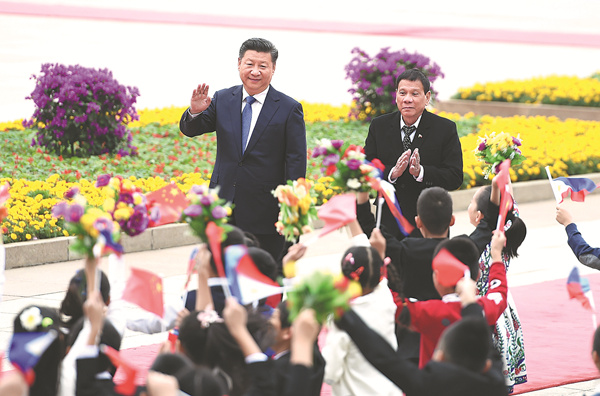
President Xi Jinping holds a welcoming ceremony to greet Philippine President Rodrigo Duterte in Beijing on October 10, 2016. Xie Huanchi / Xinhua |
ASEAN member countries kept close tabs on Rodrigo Duterte’s visit to China but also kept a second eye on the Philippine island of Luzon, which was struck by Typhoon Karen. The storm might bring ASEAN closer towards regional integration. The quick response and timely evacuation showed that the nation, along with ASEAN's support, is much better prepared to tackle natural threats than before.
This has implications not only for ASEAN integration but for the trading bloc’s future talks with China which have been scuppered by disagreements in recent months. Thanks to the cooperation of the region, the pre-emptive evacuation of 291 families was not only well planned, but apparently well communicated to senior members of the disaster management council and the general public.
By comparison, the devastating effects of Typhoon Yolanda (also known as Haiyan), in November 2013, not only resulted in a terrible tragedy, but also damning evidence of communication failures in the Philippines at the time due to the lack of access to reliable information from government officials as ineffective early warnings systems were compounded by a lack of preparedness.
Since Cyclone Nargis in Myanmar in 2008, which killed more than 130,000, ASEAN has been developing an Emergency Rapid Assessment Team. Disaster response and preparation is managed by each ASEAN member individually, but they meet regularly to discuss policy and best practices through the ASEAN Humanitarian Assistance (AHA) Centre set up in 2011. This has allowed members to share a constant stream of information especially in weather forecasts and multi-hazard mapping.
Importantly, it has also allowed countries to share ideas and improve response times and establish best practices in the region as evidenced by the organized and prepared response to Karen, compared with Yolanda in 2013.
The southeast coast of China is also vulnerable to weather related disasters such as typhoons, and China will be following the progress in ASEAN’s integration and communication methods closely. Rodrigo Duterte’s visit to Beijing may leave some opportunity for increased pan-Asian collaboration in the future.
The recent establishment of the National Institute of Emergency Management (NIEM) has allowed China to broaden its disaster management vision and increase the number of publications in English. The NIEM has sought to enhance China’s engagement on disaster management with ASEAN. A program established in 2013 brought Thai and Chinese experts to training programs for disaster management officials and practitioners, and increased disaster management networking between ASEAN countries and China.
Commentators have noted the lack of funding for the AHA in Southeast Asia as a point of weakness, and it has marred the center's ability to implement an effective program of “building disaster-resilient nations into actions and initiatives focusing particularly on the most vulnerable high risk communities,” part of ASEAN’s Vision 2025.
By comparison Chinese policymakers have successfully established state-of-the-art operating systems, including three unmanned drones, to monitor natural phenomena. Future discussions between ASEAN, China and the Philippines may include investment in disaster management as a relatively simple first step towards greater regional integration.
It is rare that disaster management is brought up specifically during political visits. However, it is a point of common ground between the two nations, both keen to keep minimize the damage from natural catastrophes. Crucially, Duterte will be searching for objective common ground, particularly given disputes in the South China Sea.
Disaster management belies the notion of national maritime borders as typhoons and earthquakes are territorially indiscriminate. This common threat has already improved early warning systems across Southeast Asia, ASEAN relations, and has saved lives. It may be a point of reconciliation between China and the Philippines in future. If disagreements derive from geographic tensions, then perhaps solutions lie there as well.
The author is a master's student in international relations at Peking University, with a focus on Southeast Asia and Central Asia.