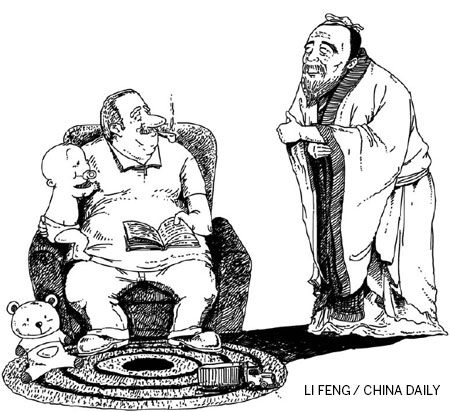
Few people realize the great appeal of Chinese thought in today's Europe. Germany, for example, is de facto undergoing a transformation away from sheer philosophical idealism toward a lofty Confucian pragmatism.
Although Germany is conservative about its deep affection for the Far East (it still doesn't officially recognize "multiculturalism"), it will adapt to China eventually - and I'm not just referring to its 28,000-odd Chinese students, the impact of Confucius Institutes on Germany's cultural centers and Germany's close economic ties with China. I base my argument about the Confucian revolution on three recent developments in Europe: in religion, education and intellectual culture.
In European culture, we see an ongoing secularization. Confucianism or ruxue was never a religion. Rather it was a code of conduct to create a harmonious society - the very kind of peaceful and tranquil society that socialist new Europe now aspires to become. The European Parliament in Brussels, unlike Europe's egocentric national governments, resembles a council of sages - pragmatic technocrats, not charismatic seducers.
Next, look at European education. It isn't complete yet, but the trend is toward the unification of its fragmented educational systems, just as China unified its examination system beginning from the Han Dynasty (206 BC-AD 220). The Bologna Accords from 1999, in particular, means better assessment and thus the promotion of ability, not birth right, as the major mechanism by which the governments should promote individuals into civil services.
This is new territory in Europe. France in the past had its exclusive club, the grandes coles, of the rich and powerful. Germany always had its three-tier school system, comparable to India's caste system. Generally speaking, in Europe the upper class and the rest never met in education in a lifetime.
The Confucian tradition, according to Peking University professor Tu Weiming, holds that all human beings have the potential to become sages or shengren. This is a bit like the Buddhist notion that all humans have a Buddha nature; it should open up attractive ways for personal growth and self-cultivation for the New Europeans.
Shengren are very different from European thinkers; they embrace the critical spirit of learning and mastering from within society, embrace social harmony, and thus cultivate a holistic worldview. Chinese wenming (civilization) has no philosophers. Philosophy is a very Hellenic and Judeo-Christian discipline. China instead has its own distinct form of humanism, like in ruxue and daojiao (Taoism).



Copyright 1995 - . All rights reserved. The content (including but not limited to text, photo, multimedia information, etc) published in this site belongs to China Daily Information Co (CDIC). Without written authorization from CDIC, such content shall not be republished or used in any form. Note: Browsers with 1024*768 or higher resolution are suggested for this site.
License for publishing multimedia online 0108263 Registration Number: 130349