Obama's strategy, now under fine-tuning, puts greater emphasis on a combination of strategies, including military, diplomatic, security and economic elements, many of which involve China. When US Secretary of Defense Leon Panetta visited Beijing, he invited China to participate in the next US-led "Pacific Rim multinational military exercise", with Washington claiming that it doesn't side with either Japan or China in the dispute over the Diaoyu Islands.
Clinton has reminded Japan to handle its relations with China carefully, because the US did not want to see the situation in the Asia-Pacific region spiral out of control. And even though the US Senate has passed an amendment to the national defense authorization bill for 2013, which emphasizes the US' right to freely navigate in the East China Sea and puts China's Diaoyu Islands under the purview of the US-Japan security treaty, the State Department is yet to comment on it.
Clinton has said the US was looking for ways to support China's peaceful rise, which is an important statement from a senior US leader. On the economic front, Obama is promoting the Trans-Pacific Partnership to develop a US-led multilateral free trade mechanism in the region to share the benefits of faster economic development in Asia-Pacific. During the East Asia Summit in Phnom Penh, Cambodia, the US decided to pull the 10 ASEAN countries into the TPP and it also welcomed China to join it. Of course, the TPP sets a high threshold for China in terms of its State-owned enterprises, government procurements and labor standards.
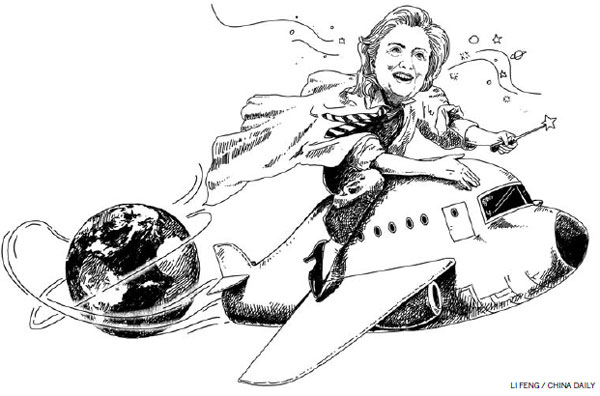
The US' strategic rebalancing toward Asia-Pacific is thus the combination of the diplomatic philosophy of Obama and Clinton, with the former as the final decision-maker and the latter as the real promoter.
But China need not worry about the US' "pivot to Asia" policy because its national strength and influence is still increasing. China and the US are highly interdependent in Asia-Pacific, and neither can enjoy complete dominance in many fields, which means they can counterbalance each other's influence as well as expand it. Based on this objective reality, leaders of both countries will continue to deal with bilateral relations from a strategic point of view.
No matter who succeeds Clinton, much can be expected from Sino-US relations. During Obama's second term, the US is likely to maintain continuity in its diplomacy despite the fine-tuning it is undergoing. Avoiding constant ups and downs in Sino-US ties is conducive to long-term strategic interests of the two countries. As far as Sino-US ties are concerned, the next US secretary of state can only go with the flow and promote positive bilateral cooperation.
The author is vice-president of China Institutes of Contemporary International Relations.
(China Daily 12/06/2012 page9)
 New type of urbanization is in the details

Copyright 1995 - . All rights reserved. The content (including but not limited to text, photo, multimedia information, etc) published in this site belongs to China Daily Information Co (CDIC). Without written authorization from CDIC, such content shall not be republished or used in any form. Note: Browsers with 1024*768 or higher resolution are suggested for this site.
License for publishing multimedia online 0108263 Registration Number: 130349