On Nov 15 Xi Jinping became general secretary of the Communist Party of China Central Committee as well as chairman of the CPC Central Military Commission.
How does China's new leader see the world, and how will he handle the country's foreign policy? Will his style and preferences differ significantly from those of his predecessors? The answers will determine China's relations with the world, and vice versa, for the next decade.
For starters, Xi is part of a generation raised and educated mostly in China's reform era, which has had a decisive influence in their lives.
China opened itself to the world in 1978, when Xi and his contemporaries were young men eager to understand the world outside China. They are a generation inspired by Deng Xiaoping's realistic approach to shattering the walls that radical leftists had built around China; a generation that believes knowledge can change the destiny of the country and its people.
When this generation assumes the mantle of leadership, its members will turn their passion and curiosity about knowledge and innovation into real work. They are surely willing to learn from the wider world as they seek to promote China's national interests abroad and encourage gradual change at home.
Xi may address Chinese diplomacy's thorniest issues - particularly relations with the United States - with more realism and flexibility than in recent years. His visit to the US in February was widely regarded as a sequel to Deng's visit in January 1979. Xi talked to President Barack Obama and visited the Pentagon. He gave a luncheon speech and saw old friends from his brief stay in Iowa as a young man. He showed interest in American culture, just as Deng did in 1979. He ate chocolate and watched NBA games.
Most importantly, instead of spending countless hours discussing political and strategic topics, he spoke directly and vigorously about the current state of Sino-US relations. "The Pacific Ocean is wide enough to accommodate the two major countries of China and the US," he declared. Unhappy with the US "pivot" to Asia, Xi remained calm, but emphasized that "one cannot rely too much on military power regarding Asia-Pacific diplomacy".
Similarly, Xi tried to avoid major arguments on human rights, saying simply: "There's no best, only better." In essence, he sought to demonstrate that however many questions, arguments and even potential conflicts exist between China and the US, both countries' leaders should address them with an attitude of cooperation and sincerity. They should not become entangled in details that fuel suspicion of their counterparts' motives, lest they lose sight of the bigger picture.
Xi's confidence extends to China's domestic politics. His generation is more certain of reform due to the country's enormous achievements in the last three decades. Xi's generation, like the founding fathers of the People's Republic, dreams of turning China into a stronger, more prosperous country. The country's new leaders want the world's applause, but they are more eager for domestic ovations.
Like previous Chinese leaders, Xi's speeches indicate he firmly believes that the world should respect China's authority to manage its own affairs. Thus, he is willing to show diplomatic muscle if China is challenged on any core area of concern. His speech in Mexico in 2009 demonstrated this. "Some foreigners with full bellies and nothing better to do engage in finger-pointing at us," he said. "First, China does not export revolution; second, it does not export famine and poverty; and, third, it does not mess around with you. So what else is there to say?"
Xi understands that the world expects not only a better China, but also a China that is committed to constructing a better world. He will be a tough and strong-minded leader, but one who understands the world in a pragmatic way and knows how to work well with his foreign counterparts.
Indeed, his 2012 visit to the US left two major impressions. First, he is a leader at ease both in front of and away from the television cameras. Second, he is not afraid to have a little fun. With those simple touches of humanity, Xi could bring more changes to China's diplomacy.
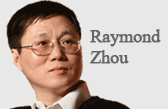
The author is deputy director of the Center for International and Strategic Studies at Peking University. Project Syndicate
(China Daily 11/29/2012 page8)



Copyright 1995 - . All rights reserved. The content (including but not limited to text, photo, multimedia information, etc) published in this site belongs to China Daily Information Co (CDIC). Without written authorization from CDIC, such content shall not be republished or used in any form. Note: Browsers with 1024*768 or higher resolution are suggested for this site.
License for publishing multimedia online 0108263 Registration Number: 130349