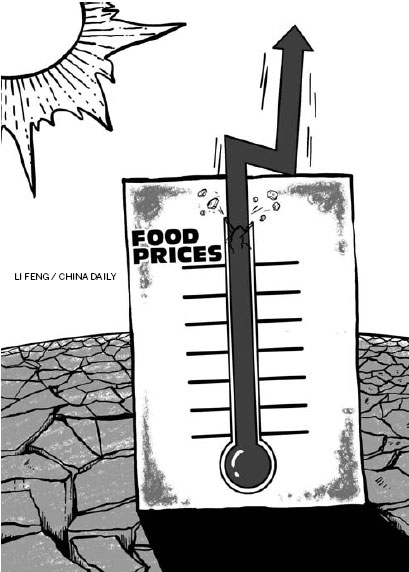
A series of natural disasters in several food producing countries have lowered current and future production forecasts and driven up prices of many staples central to the global agricultural market. Much of the United States is experiencing the worst drought since the 1950s. About 75 percent of the corn and soybean production in the US is being affected by drought "considered severe or greater", as reported by the Economic Research Service of the US Department of Agriculture.
The US is the world's largest producer and exporter of corn and soybean, and its export prices for the two products have increased by a record 30 and 18 percent since June, according to the UN Food and Agriculture Organization.
In India, poor monsoon may reduce rice production by 5-8 percent. A similar story is being played out in Russia, where soaring temperatures and reduced rainfall in June and July have lowered wheat production outlooks.
Russia is the world's third largest exporter of wheat, and its production in 2012-13 is expected to fall by 13.2 million tons, a 24 percent drop compared with last year, according to the Foreign Agricultural Service of the USDA. Global wheat prices have increased by 26 percent in the past three months. Flash floods on Russia's Black Sea coast in early July have created further export complications, causing infrastructure damage to the country's major point of grain export.
In Northern China, the worst floods in 60 years have affected nearly 1 million hectares of farmland, according to the Xinhua News Agency. Agricultural production in other parts of the country has also suffered as the Yellow and Huai river regions have seen below average rainfall since the beginning of June, which has created drought-like conditions in 5 million hectares of farmland. Similar trends are being seen in other major food producing countries across the world.
Reduction in agricultural production because of natural disasters appears to be the main reason behind the recent increases in prices for staples. Other factors, however, could also have played a part. Monetary easing through interest rate cuts by many countries - most notably the US, the European Union and China - to address the lingering effects of the global recession may also contribute to a slight increase in retail prices of food across the world.
As reported by the Economic Research Service of the USDA, retail food price inflation has averaged 2.5-3 percent in the past two decades. Though food price inflation for 2012 is forecast at 3-4 percent, it will still remain below inflation spikes of recent years, including that seen during 2007, 2008 and 2011.
Increase in biofuel production is another reason for potential price increase, because ethanol production generates food-fuel competition. In the US, for example, 40 percent of the corn crop is currently being used for biofuel production.
High and volatile prices can have drastic effects on the purchasing power of poor and vulnerable groups in emerging nations. This is especially true of countries that are highly dependent on imports to meet their food security needs. As seen during the food price crisis of 2007-08 the effects of price rises in domestic markets can strongly influence global markets, and vice versa. For example, in Mexico and Egypt, the second and fourth largest importers of US corn, imports account for 26 and 42 percent of the total corn available.
In Mexico and China, the two largest importers of soybean among developing countries, imports make up 88 and 45 percent of their total soybean supply. Egypt and Brazil, the two largest importers of wheat, import more than half of their total wheat supply. As food prices increase in exporting countries, import-dependent countries are likely to feel the ill effects of these spikes.
Several urgent actions have to be taken to address the current situation and prevent a potential global food price crisis. First, key institutions, including USDA, FAO, UN Conference on Trade and Development, World Bank and the World Food Program, in collaboration with local partners, should closely monitor key developments in food supply, consumption, prices and trade, as well as agricultural commodity speculation to quickly detect any imbalance and facilitate a swift response.
Second, the use of food crops to make biofuels, particularly in the US and the EU, should be reduced by stopping corn-based biofuel production to relieve the pressures on the domestic as well as global food markets.
Third, countries must try to avoid banning exports and going on a panic buying spree, which lead to tighter market conditions and exacerbate food price hikes.
Fourth, countries should be ready to use some of their grain reserves to address food emergencies, with emphasis on vulnerable populations.
Fifth, countries have to ensure that WFP has easy access to food purchases for emergency relief efforts.
And last, developing countries' agricultural output and productivity have to be boosted, especially for smallholder farmers, by giving them access to improved agricultural inputs, advanced technologies and helping develop their rural infrastructure. This is important to reduce the effects of high and volatile prices on their national food security.
Also, food production in developing countries must adapt to climate change that will cause more frequent and extreme weather events.
The author is director general of International Food Policy Research Institute based in Washington.
(China Daily 08/22/2012 page9)
 New type of urbanization is in the details

Copyright 1995 - . All rights reserved. The content (including but not limited to text, photo, multimedia information, etc) published in this site belongs to China Daily Information Co (CDIC). Without written authorization from CDIC, such content shall not be republished or used in any form. Note: Browsers with 1024*768 or higher resolution are suggested for this site.
License for publishing multimedia online 0108263 Registration Number: 130349