The National Copyright Administration released for comment a draft Copyright Law on its official website on March 31. It provoked an immediate and heated response, especially from the music industry which has shown unprecedented unity and publicly submitted suggestions to the legislature in the name of the China Audio-Video Association Recording Works Council and the China Musicians Association Pop Music Society.
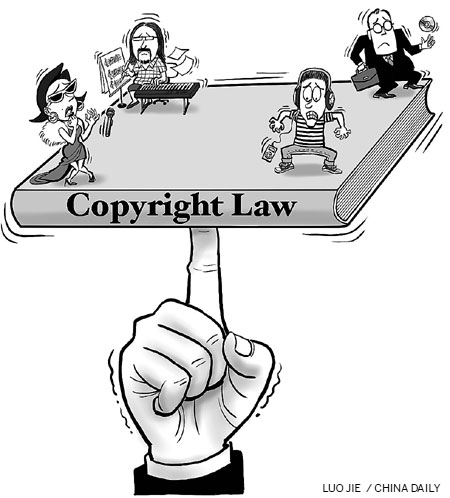
Composers, songwriters and Record Companies are strongly opposed to the draft amendments as they believe it will undermine their rights if passed.
Article 46 of the draft stipulates that three months after a recording is released it can be used to make new recordings by non-copyright owners as long as they apply to the copyright authorities, pay remuneration to the owners and clearly state the copyright owner.
The draft deletes the proviso in the existing law that: "No such work may be used where the copyright owner declares that use is not permitted."
"If the provisions are passed, that will undermine the enthusiasm of music writers and even China's music industry," Song Ke, chief executive officer of Taihe Rye, a record company based in Beijing, was quoted as saying in China Youth Daily.
Industry insiders are also concerned that the provisions will make record companies less willing to invest in recording and promotion.
"Once the law takes effect, no company will want to invest in music recordings, which will destroy the fragile domestic music industry," Zhou Yaping, CEO of New Run Entertainment and executive vice-president of the Recording Works Council, told the media at a news conference.
Record companies will not be able to recover the costs of producing recordings and promoting singers within three months, Zhou said.
To safeguard their interests, music industry practitioners suggest extending the time limit and preserving the original proviso.
Statistics provided by Lu Jian, president of Ocean Butterflies International and secretary-general of the Recording Works Council, show that the music industry's revenues from recordings decreased sharply in 2011 to about 100 million yuan ($15.9 million), down from 2 billion yuan a decade before. Currently no domestic music company is listed and no domestic record company has more than 100 employees.
However, the National Copyright Administration says the revised law aims to regulate the rights of the copyright holders and facilitate the proper use of copyrighted works.
"We take this provision very seriously, and will seek a solution that can best balance various rights and claims," Yan Xiaohong, deputy director of the National Copyright Administration, said at a news conference.
Wang Ziqiang, director of the legal affairs department of the National Copyright Administration stresses that "making a sound recording based on the original one is a process of recreation that adds value to the former, which is different from a photocopy".
Li Mingde, a researcher at the Intellectual Property Rights Center with the Chinese Academy of Social Sciences, has pointed out that the Copyright Law is not merely to protect copyright owners, but also to balance their interests with the interests of communicators, users and the public.
Each side can find related copyright regulations from other countries to support their argument, and the international agreement governing copyright, the Berne Convention for the Protection of Literary and Artistic Works, permits member countries to independently decide whether to adopt the statutory license or not depending on their domestic situations.
But protecting the rights of copyright owners is the precondition for guaranteeing the interests of communicators, users and the public. Without the copyright owners' creation, there's no musical works at all. If musicians lose their enthusiasm to create music, what is there to communicate and enjoy? Thus the opinions of composers and songwriters and record companies should be seriously considered, because they not only reflect their own interests, but also the public's interests.
However, no matter what the final outcome is, the controversy surrounding the draft is a good thing because public discussion and positive interaction among different interest groups is the indispensable procedure of lawmaking. It's the right of different groups to openly express their opinions and try to safeguard their interests under the framework of the law. Although no law can satisfy everyone, the legislature must truly try and balance the various interests, because a good law must be the one that sticks to the principle of justice and fairness.
The author is a writer with China Daily.
wangyiqing@chinadaily.com.cn
(China Daily 05/08/2012 page9)


Copyright 1995 - . All rights reserved. The content (including but not limited to text, photo, multimedia information, etc) published in this site belongs to China Daily Information Co (CDIC). Without written authorization from CDIC, such content shall not be republished or used in any form. Note: Browsers with 1024*768 or higher resolution are suggested for this site.
License for publishing multimedia online 0108263 Registration Number: 130349