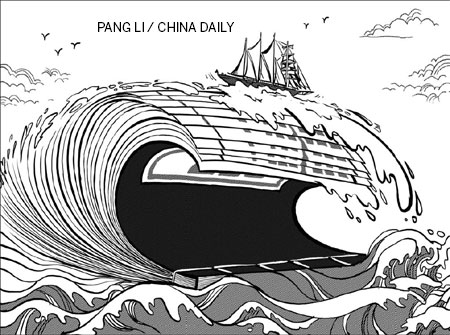
It was two o'clock in the afternoon when I phoned the hotel room to be greeted by unexpected - "Wei?"
I was calling 84-year-old Leonard J. Swidler, professor of catholic thought and interreligious dialogue at the Philadelphia-based Temple University in the United States to let him know I was about to knock on his door.
Two minutes later I was in his hotel room, and a wonderful hour's conversation on Confucianism and its dialogue with Western traditions began.
Swidler was visiting Beijing to give a speech on the dialogue between Confucianism and Western traditions at Peking University.
He received a Catholic education for 16 years, but he has studied several other major traditions like Confucianism, Islam and Buddhism, and he advocates studying them all rather than only one.
In 1978 he founded the Dialogue Institute with the aim of fostering interreligious and intercultural scholarship, understanding and cooperation. Since then he has travelled the world to promote dialogue among the different traditions, which he thinks is vital because "no tradition can cover the whole truth, they need each other".
Swidler sees the various traditions as moral guides that offer us a way to live a meaningful life. Confucianism shares much in common with Western traditions in this aspect, he said, pointing out that it is the same pursuit of goodness that defines all the world's great systems of thought.
He said their differences are complementary rather than contradictory, as they do not contradict one another when it comes to certain basic values like love, liberty and happiness.
That makes a global dialogue between Confucianism and Western traditions both possible and necessary, he said, as only by sharing with each other "the best of their long traditions" can both sides progress together.
"Confucians advocate a humanism which neither denies nor slights the transcendent," said Swidler, pointing out that Confucianism ultimately pursues harmony between the way of humans (rendao) and the way of heaven (tiandao).
Confucian harmony even extends to people's relations with nature as it says we have a responsibility towards everything around us, an idea that is increasingly relevant today as we combat environmental degradation and climate change.
This prevented Confucianism from discriminating against other traditions, Swidler said, something that followers of the traditions can learn from as they tend not to accept the other traditions as equal partners for dialogue.
Confucianism, although historically the guiding principle of the State, has been able to coexist with other traditions and learn from them and that is a precious legacy for the country today.
But Confucianism too has its rigid side, Swidler pointed out.
It emphasizes the maintenance of order through li (the natural order), which emphasizes five relationships: those between ruler and ruled, father and son, elder brother and younger brother, husband and wife, friend and friend. Originally the stress was laid on their mutual duties, but that has been distorted to justify giving obedience and respect to a superior and in turn darkened Confucianism's sense of equality, he said.
"One was still to love fellow human beings, but the respect and love one showed to someone was determined by their place in society," he said, adding that this prevents equal dialogues.
He is optimistic that the deficiencies of Confucianism and the other traditions can be changed through dialogue so that they interact and learn from each other. But that will require, and in turn urges, more and deeper interactions, he said.
Swidler believes it is intellectuals' responsibility to promote dialogue that will ultimately lead towards a better future.
"There might be dark days, dark years, even dark ages, but we are always heading towards light in the long run, and I'm confident we will embrace brightness together."
The author is a writer with China Daily.
Zhangzhouxiang@chinadaily.com.cn
(China Daily 04/25/2012 page9)
 New type of urbanization is in the details

Copyright 1995 - . All rights reserved. The content (including but not limited to text, photo, multimedia information, etc) published in this site belongs to China Daily Information Co (CDIC). Without written authorization from CDIC, such content shall not be republished or used in any form. Note: Browsers with 1024*768 or higher resolution are suggested for this site.
License for publishing multimedia online 0108263 Registration Number: 130349