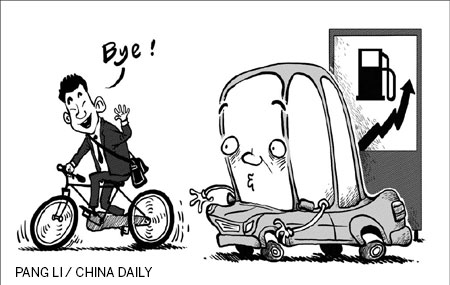
Just when Chinese cities are reaching saturation point with automobiles, the wheels are falling off the love affair with private cars, as millions of drivers now think twice before using their prized machines. Rising petrol prices are the main factor behind this trend, but parking and maintenance costs and a possible accident all help tilt the scales in favor of alternative means of transport. This trend will accelerate and city planners should act now to implement intelligent long-term policies.
In the past decade the private car has become an object of worship in Chinese cities, the slightest bump necessitating hours of on-the-spot anguished scrutiny that in all likelihood will bring traffic to a standstill. The English like to say that a man's home is his castle; in China a man's castle is his car, a private space here he can feel safe from the hostile forces besieging him on all sides.
The big drawback to using a car, of course, is actually trying to get anywhere, as in most cities the traffic is bumper to bumper. TV advertisements - and the billboards staring you in the face when you crawl along at a pace slower than a snail - like to show a car cruising a long, open road with no other vehicle in sight. But reality fails to live up to its billing and instead its stop-start chock-a-block from home to office and back again. Surveys show the average commuting time in Chinese cities is just under an hour, with drivers having slightly shorter travel times than those using public transport, except when accidents or weather add hours to the journey.
While the authorities can be proud of private car ownership as a symbol of people's improving standards of living, it was insightful for the acquisition of General Motor's Hummer brand by a Sichuan engineering firm to be quashed and to introduce the increased sales tax for larger capacity engines.
The next step will be gradual but inexorable rise of fuel prices and a new thoughtfulness in driving anywhere.
There is nothing more certain than the fact that the amount of crude oil on Earth is finite. Production peaked in North America 40 years ago, and major oilfields around the world are peaking and declining. The supply of cheap oil is dwindling, deep-sea oil is proving hard to get and the alternative energies now promoted are admirable in intent, but despite increasing research and development, once said to be withheld due to the machinations of the oil companies, they will never have the compact explosive force of fuel injection.
It is inevitable that the oil industry that drove development for a hundred years will itself run out of gas. This requires planners adopt a different mindset. The cities that cleverly emphasize efficient public transport and are friendly to bikes will be the cities that thrive in the future.
Some European cities have shown what farsighted policies in efficient transport can achieve. A comprehensive plan integrating mass transport with cycling can take on its own momentum and become popular and grow, as has been proven in Germany, Denmark and the Netherlands. A survey led by Rutgers University found that half of the population of Amsterdam ride a bike on a daily basis. The major improvements this brings to health and clean air are a bonus that Chinese urbanites desperately need.
As opposed to the famous dictum of Ma Nuo, who is an outspoken participant of a TV matchmaking program, - "I'd rather cry in the back of your BMW than laugh on the back of your bicycle", we should heed the maxim, Daodejing quips. Just as Chinese philosopher Laozi said, he knows he has enough is rich. We should respect people who have enough sense and humility to use efficient environmentally friendly transport. In these days of global warming, cycling is cooler than driving.
The author is an Australian researcher collaborating with Chinese academic and commercial institutions.
(China Daily 04/18/2012 page9)
 New type of urbanization is in the details

Copyright 1995 - . All rights reserved. The content (including but not limited to text, photo, multimedia information, etc) published in this site belongs to China Daily Information Co (CDIC). Without written authorization from CDIC, such content shall not be republished or used in any form. Note: Browsers with 1024*768 or higher resolution are suggested for this site.
License for publishing multimedia online 0108263 Registration Number: 130349