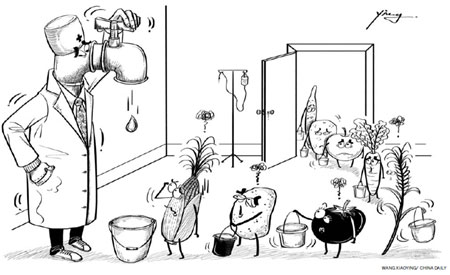
Thursday was World Water Day, and the theme this year was "water and food security".
Actually China's shortage of water has posed a huge challenge to the country's food security for years. In its southwestern provinces, a drought that has already lasted for three successive years is threatening farmers' crops, and similar droughts threatening water supplies and food production can be found in the central and eastern provinces.
The government is making huge efforts to address the nation's severe water challenges. Last year's No 1 central document emphasized the importance of water facilities and the government also introduced fresh regulations on "water resources management" in February.
Non-governmental organizations (NGOs) are also lending a helping hand. Since July 2011, for instance, Oxfam, a leading international aid and development charity, has provided over 7.5 million yuan ($1.18 million) to provide emergency aid for 100,000 people in the areas most seriously affected by drought.
However, the efforts of the government and NGOs need support, especially the cooperation of agricultural enterprises. There are an increasing number of enterprises devoting themselves to agriculture in rural regions. By the beginning of 2012, there were already over 110,000 agricultural enterprises involving over 100 million agricultural households in the country. These enterprises exploit huge amounts of rural resources, of which underground water is possibly the most important.
According to reports of the United Nations Food and Agriculture Organization, watering crops accounts for the majority of water usage in China, more than 60 percent. Regulations are needed to control this use. There are warnings in other countries that China would do well to heed. In the United States for instance, over exploitation of underground water has caused the decline of wetland and increase of desertification in Ogallala Aquifer.
In the North China plateau, over-exploitation has already caused the underground-water level to drop resulting in land subsidence. During my visit to the region two years ago, many farmers living around a large plantation operated by an enterprise complained that they had to pay "over 16 times the money" to dig a deeper well as the ones they had been using had dried up, and even the deep ones were having increasing difficulty in pumping out water.
Currently the laws in China have certain bindings on enterprises extracting water. According to the Water Law and its attached regulations, unless included in one of five specific exclusions, such as family use and small amounts, all individuals and organizations need to apply for permits and pay the required fees in order to exploit water resources. In the process the applicant is asked to submit evaluation reports of its potential effects upon the environment, and all the information should be made public so that residents are aware of where the water is going.
However, during my visit to some enterprises in North China, I found that the permit system does not cover all agricultural projects. It is not uncommon for a rural enterprise to mass exploit water resources without any permit at all; in other words, no one knows or seems to care how much water these enterprises are using and what effects that might have on water resources and the environment.
That must be changed to let more people know what happens to the water they need to live.
There are a number of things that can be done to better protect water resources in China. First, governmental departments need to introduce favourable policies to encourage agricultural enterprises to reduce the amount of water they use. The legislative branches can also consider revising the law to further distinguish between enterprises exploiting water resources for business use and residents for life use.
Second, agricultural enterprises should promote transparency by publicizing their usage of water, and inform the local residents about what effects their business might have on the water they rely on for life.
Last, but no less important, NGOs and social media outlets can play a bigger role; the former can use their resources to help the people in need, while the latter can help supervise the usage of water by enterprises.
The author is campaign officer of Corporate Social Responsibility Advocacy, Policy and Campaign Unit, Oxfam Hong Kong.
(China Daily 03/23/2012 page9)
 New type of urbanization is in the details

Copyright 1995 - . All rights reserved. The content (including but not limited to text, photo, multimedia information, etc) published in this site belongs to China Daily Information Co (CDIC). Without written authorization from CDIC, such content shall not be republished or used in any form. Note: Browsers with 1024*768 or higher resolution are suggested for this site.
License for publishing multimedia online 0108263 Registration Number: 130349