When I visited China in 2006 for the first time, I had the same preconceived notions about the country as most Westerners. In fact, I was a bit scared to get off the plane because I thought that in a "totalitarian" state where everybody was under surveillance, all my movements would be monitored.
But I could not have been more wrong. People, including policemen, were friendly and ready to help.
After delivering my lectures in Dalian, Liaoning province, and Shanghai, I spent one month traveling around China with my wife. I sought the help of a Chinese friend to book air tickets and get hotel reservations. Where would we go? I wanted to see her reaction when I said "Lhasa", capital of the Tibet autonomous region. "No problem," said my friend. I got the same answer when I told her that we also wanted to go to the Xinjiang Uygur and Inner Mongolia autonomous regions and Yunnan province.
Lhasa was very clean and organized where one could get anything, including fresh grapes and other fruits. We hired a guide just during our visits to Potala Palace and Jokhang Temple. For the rest of our stay in Lhasa, we were alone and went wherever (and did whatever) we wanted to. People, of course, were curious, but in a friendly and natural sort of way. Few spoke English but talking with them was a great pleasure.
We saw very few policemen and most of them were Tibetans. Thanks to our visit to Tibet, we realized that for ordinary people, religious practices are part of everyday life. All official signs in Lhasa are both in Tibetan and Chinese languages, with the former preceding the latter in most. In the parks in front of Potala Palace, Tibetans from the countryside were having picnics and enjoying their visit to Lhasa. So all this Western talk about China "suffocating Tibetan language and culture" is nothing but a lie.
What I saw in Tibet was the exact opposite of what I had read in the Western media.
In 2010, I visited the monastery town of Kum-Bum and Kuku-Nor Lake in Qinghai province, where I did not see anything unusual either.
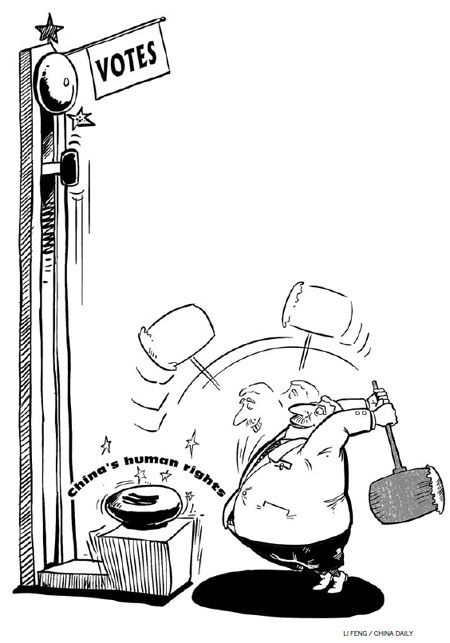
So why does the West keep lecturing China on human rights?
It is true that there are many poor people in China, but at least they get enough food to eat and have a place to sleep. In New York's Manhattan, for instance, I have seen a father searching for food in the streets for his four children. He even searched a waste-bin where he found a piece of dry bread, which he rubbed on his coat and gave to his smallest child.
In China, I have also visited places where ethnic groups live but I have not seen real misery among the people. Since I am a member of the Swedish-speaking minority in Finland, I am very sensitive to "ethnic" questions, for I know what they signify.
I have always felt safe in China but not in the United States. I have seen people with guns in the US, and I do not consider carrying guns to be freedom. A person is neither using his human rights nor exercising his freedom when he points a gun at you just because you ask for a hotel room late in the evening.
That's why I think foreigners criticizing China for its human rights record are just trying to hide the human rights problems in their own countries.
True, there were riots in Lhasa in 2008, but the rioters had received instructions from outside China to create trouble and prompt the international community to boycott the Beijing Olympic Games. The riots were the handiwork of people desperate to foment trouble across China, but their attempt failed miserably.
The US and Europe are mired in their debt crises. And given that presidential elections will be held in the US, France and other countries this year, it's easier for politicians to blame other countries for the situation to win people's sympathy and votes. Why didn't the Western media play up the Occupy Wall Street movement or the London riots and attribute them to bad human rights records?
I have lived in China for one and half years, and I think the West can learn many things from China, especially how to improve poor people's lives. After all, China has lifted more than 600 million people out of poverty in the past three decades.
I hope the West stops this blame game and learns from China's experience on different fronts.
The author is a Finnish scholar.
(China Daily 02/17/2012 page9)
 New type of urbanization is in the details

Copyright 1995 - . All rights reserved. The content (including but not limited to text, photo, multimedia information, etc) published in this site belongs to China Daily Information Co (CDIC). Without written authorization from CDIC, such content shall not be republished or used in any form. Note: Browsers with 1024*768 or higher resolution are suggested for this site.
License for publishing multimedia online 0108263 Registration Number: 130349