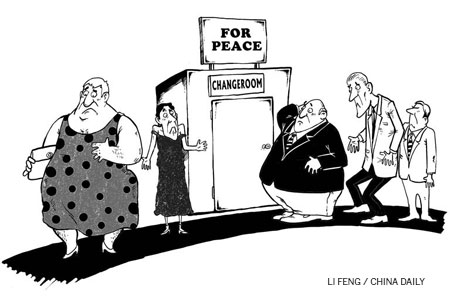
Would the world be more peaceful if women were in charge? A challenging new book by the Harvard University psychologist Steven Pinker says that the answer is "yes".
In The Better Angels of Our Nature, Pinker presents data showing that human violence, while is still very much with us today, has been gradually declining. Moreover, he says, "over the long sweep of history, women have been and will be a pacifying force. Traditional war is a man's game: tribal women never band together to raid neighboring villages." As mothers, women have evolutionary incentives to maintain peaceful conditions in which to nurture their offspring and ensure that their genes survive into the next generation.
Skeptics immediately reply that women have not made war simply because they have rarely been in power. If they were empowered as leaders, the conditions of an anarchic world would force them to make the same bellicose decisions that men do. Margaret Thatcher, Golda Meir and Indira Gandhi were powerful women; all of them led their countries to war.
But it is also true that these women rose to leadership by playing according to the political rules of "a man's world". It was their success in conforming to male values that enabled their rise to leadership in the first place. In a world in which women hold a proportionate share (one-half) of leadership positions, they might behave differently in power.
So we are left with the broader question: does gender really matter in leadership? In terms of stereotypes, various psychological studies show that men gravitate to the hard power of command, while women are collaborative and intuitively understand the soft power of attraction and persuasion. Americans tend to describe leadership with tough male stereotypes, but recent leadership studies show increased success for what was once considered a "feminine style".
In information-based societies, networks are replacing hierarchies, and knowledge workers are less deferential. Management in a wide range of organizations is changing in the direction of "shared leadership", and "distributed leadership", with leaders in the center of a circle rather than atop a pyramid. Former Google CEO Eric Schmidt said that he had to "coddle" his employees.
Even the military faces these changes. In the United States, the Pentagon says that army drillmasters do "less shouting at everyone," because today's generation responds better to instructors who play "a more counseling-type role". Military success against terrorists and counterinsurgents requires soldiers to win hearts and minds, not just break buildings and bodies.
Former US president George W. Bush once described his role as "the decider," but there is much more to modern leadership than that. Modern leaders must be able to use networks, to collaborate, and to encourage participation. Women's non-hierarchical style and relational skills fit a leadership need in the new world of knowledge-based organizations and groups that men, on average, are less well prepared to meet.
In the past, when women fought their way to the top of organizations, they often had to adopt a "masculine style", violating the broader social norm of female "niceness". Now, however, with the information revolution and democratization demanding more participatory leadership, the "feminine style" is becoming a path to more effective leadership. In order to lead successfully, men will not only have to value this style in their women colleagues, but will also have to master the same skills.
That is a trend, not (yet) a fact. Women still lag in leadership positions, holding only 5 percent of top corporate positions and a minority of positions in elected legislatures (just 16 percent in the US, for example, compared to 45 percent in Sweden). One study of the 1,941 rulers of independent countries during the 20th century found only 27 women, roughly half of whom came to power as widows or daughters of a male ruler. Less than 1 percent of 20th-century rulers were women who gained power on their own.
So, given the new conventional wisdom in leadership studies that entering the information age means entering a woman's world, why are women not doing better?
Lack of experience, primary caregiver responsibilities, bargaining style, and plain old discrimination all help to explain the gender gap. Traditional career paths, and the cultural norms that constructed and reinforced them, simply have not enabled women to gain the skills required for top leadership positions in many organizational contexts.
Research shows that even in democratic societies, women face a higher social risk than men when attempting to negotiate for career-related resources such as compensation. Women are generally not well integrated into male networks that dominate organizations, and gender stereotypes still hamper women who try to overcome such barriers.
This bias is beginning to break down in information-based societies, but it is a mistake to identify the new type of leadership we need in an information age simply as "a woman's world". Even positive stereotypes are bad for women, men, and effective leadership.
Leaders should be viewed less in terms of heroic command than as encouraging participation throughout an organization, group, country or network. Questions of appropriate style - when to use hard and soft skills - are equally relevant for men and women, and should not be clouded by traditional gender stereotypes. In some circumstances, men will need to act more "like women"; in others, women will need to be more "like men".
The key choices about war and peace in our future will depend not on gender, but on how leaders combine hard- and soft-power skills to produce smart strategies. Both men and women will make those decisions. But Pinker is probably correct when he notes that the parts of the world that lag in the decline of violence are also the parts that lag in the empowerment of women.
The author, former US assistant secretary of Defense, is a professor at Harvard and the author most recently of The Future of Power.
Project Syndicate
(China Daily 02/10/2012 page9)
 New type of urbanization is in the details

Copyright 1995 - . All rights reserved. The content (including but not limited to text, photo, multimedia information, etc) published in this site belongs to China Daily Information Co (CDIC). Without written authorization from CDIC, such content shall not be republished or used in any form. Note: Browsers with 1024*768 or higher resolution are suggested for this site.
License for publishing multimedia online 0108263 Registration Number: 130349