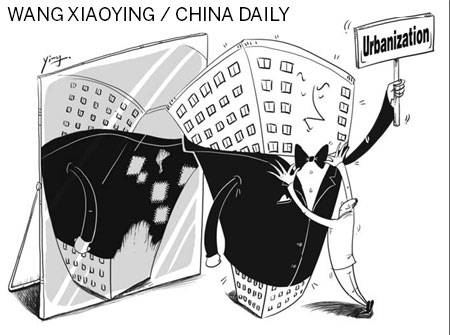
China is now entering an urban age. According to the National Bureau of Statistics, China's urban population reached 690 million in 2011, accounting for 51.27 percent of the total population. Now, more than half of China's population lives in cities and towns. The country has reached a profound historical milestone; it has bid farewell to traditional rural society and joined the urban world.
China's urbanization is an event of global significance not only because the scale and pace of urban expansion is unprecedented in world history, but also because the process of urbanization is deeply embedded in the global economy. China's urbanization is becoming the engine of global economic growth.
Unlike the flocking of farmers into the slums of "third world cities", a process known as "pseudo-urbanization", the swelling of China's urban population is driven by the jobs created in cities in association with the "factory of the world". The pace of urbanization has been determined by the world demand for Chinese workers and the products they make.
China's urbanization is accompanied by substantial industrialization. The intertwined processes of urban growth and industrial development mean that China's urbanization is productive - it is a process of wealth creation.
But the driving force building the world factory has also led to incomplete urbanization. Rural migrants flow into the cities and become urban workers. However, they have not been truly integrated into urban society as urban dwellers or citizens. Rural migrants are uprooted from rural society and become "sojourners" in the cities. The sense of placeless of the migrant population is a profound challenge for Chinese society, which has previously been rooted to the soil.
In the building of cities, local governments get incentives from land revenue, which has fostered the pace of urbanization. Building larger cities is becoming a slogan for economic growth. Large stretches of rural land are being converted into residential areas, attracting speculative investors. Some are becoming ghost towns.
In contrast to unoccupied formal housing, informal housing in "urban villages" is a major source of shelter for millions of rural migrants. Despite under-serviced and low-quality housing, migrants are not necessarily unhappy about their housing conditions in the cities. Although they prefer strongly to stay in cities, their sense of attachment to them is low. The sense of alienation among second-generation migrants is especially strong. And social exclusion is creating a new dualism in cities.
Seeing "urban villages" as the "cancer of cities" and "anomalies of modern society", local governments are keen to improve the image of the cities. The demolition of "urban villages" has thus become a de facto tactic to modernize Chinese cities, without recognizing that informal housing is the only affordable option for rural migrants.
So what went wrong with Chinese urbanization? The problem is the idea of taking a city as a place for production rather than a community of people. We have seen the urbanization of land and jobs, but not the urbanization of people. Ultimately, it is the urbanization of people that should be regarded as the genuine and progressive transition toward the urban world.
Despite their dilapidated appearance, Chinese "urban villages" are not "slums of despair". Most of the people who live there have jobs and work hard to earn a living. Because of convenient locations, in "urban villages" there are usually many shops, restaurants, markets, barbers, and real estate and job agents, targeting the low-income migrant population. What are lacking perhaps are adequate toilets, kindergartens, schools, clinics and other social service facilities.
Forcing informal housing to upgrade into high-standard market housing inevitably dispels the residents to move to places further away where the rent is more affordable. The conditions in "urban villages" may not be ideal but at least they accommodate the normal family life, better than the more orderly and cleaner factory dormitories. "Urban villages" as migrant enclaves serve as a more human environment than the outsider might perceive.
To reduce the resistance toward village redevelopment, the current practice of demolishing villages is aimed at compensating more generously the original villagers, whereas the living conditions of rural migrant renters is hardly considered. To balance the cost of compensation, developers are usually allowed a much higher plot ratio, namely selling additional space in high-rises to generate profit. This approach will eventually turn low-rise village housing upward into a "vertical urban village".
While affordable housing in "urban villages" is disappearing, local governments often choose suburbs or even exurbs to build large-scale affordable housing projects. These projects create a huge financial pressure on local fiscal budget and can potentially lead to the long-term problem of "council estates" or "tower blocks" seen in Western countries. The large scale of concentrated public housing built in the 1960s in these economies has led to high concentration of social deprivation.
Nowadays, many so-called eco-cities are built in suburbs. But developing these places is hardly eco-friendly because of the need for long-distance commuting. Rather, many "urban villages", because of their convenient locations, spontaneously evolve into popular housing markets and densely populated communities. They are close to workplaces and services. Public transport is the norm rather than exception for "urban village" dwellers. So are we missing an opportunity to turn "urban villages" into genuine sustainable and eco-friendly places by demolishing them?
In short, the urban age is full of promises and challenges. For a socially and ecologically sustainable urban future, we must remember that urbanization is ultimately about people and their changing ways of life.
The author is Bartlett Professor of Planning at University College London.
(China Daily 02/06/2012 page9)
 New type of urbanization is in the details

Copyright 1995 - . All rights reserved. The content (including but not limited to text, photo, multimedia information, etc) published in this site belongs to China Daily Information Co (CDIC). Without written authorization from CDIC, such content shall not be republished or used in any form. Note: Browsers with 1024*768 or higher resolution are suggested for this site.
License for publishing multimedia online 0108263 Registration Number: 130349