Exactly 100 years ago, an unexpected explosion at midnight in Wuchang city, Hubei province, triggered a decisive event in China's modern history: the 1911 Revolution. In less than five months, the last emperor Aisin-gioro Pu Yi abdicated, and the Qing Dynasty (1644-1911) and the monarchy that had ruled China for more than 2,000 years were overthrown.
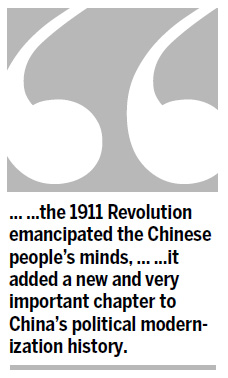
The end of the monarchy had a far greater impact on the people than the overthrowing of the last emperor, says Li Wenhai, a historian at Renmin University of China. In a recent article for People's Daily, Li writes: "By answering two politically decisive questions, the 1911 Revolution emancipated the Chinese people's minds," He says and stresses that it added a new and very important chapter to China's political modernization history.
The revolution's first subversive answer was to the question: where the legality of state sovereignty comes from. For more than 2,000 years, the emperor was considered a divine power sent from heaven to rule China. This rule had become "sacred and inviolable".
But the 1911 Revolution declared that autocratic monarchy was evil, dark and "intolerable to a people that love liberty", and called upon "people to attack anyone who wanted to assume (or restore) the throne". Besides, the revolution's leader Sun Yat-sen and his Tongmenghui (China Revolutionary Alliance) declared that "the state belongs to and should be managed by all the people", and made this principle part of the newborn Republic of China's provisional constitution.
The second subversive answer that the 1911 Revolution threw was on the condition of the ordinary people in China. Guided by modern ideas, the revolution's leaders declared that "all people are equal" and included basic human rights in their slogans, which later became part of the republic's constitution. For the first time, ordinary people learned that they, as owners of the state, had the natural right to rule it, something that the monarchy had denied them for centuries.
No sooner was the republic founded did the revolution's leaders abolish inhuman practices such as civilians kneeling before officials and rich people "raising" serfs, and thus gave people a taste of liberty and equality in the truest sense of the terms, Li writes.
Perhaps a remark made by Sun Yat-sen best describes the situation people were faced with in 1912: "Those who dared not, could not and would not be masters are masters now."
The two principles, although not fully realized in actual politics, liberated people's minds by eliminating their superstition and fear of imperial power, and introduced them to modern republican principles, Li writes. Although at times some officials have abused power to violate democratic norms, monarchy was never again established in China since the revolution. Supporters of monarchy did try to restore system twice after the revolution - Yuan Shikai in 1916 and Pu Yi in 1917 - but they faced opposition from the entire nation. The result: the first restored monarchy lasted only 83 days and the second, 12 days.
 New type of urbanization is in the details

Copyright 1995 - . All rights reserved. The content (including but not limited to text, photo, multimedia information, etc) published in this site belongs to China Daily Information Co (CDIC). Without written authorization from CDIC, such content shall not be republished or used in any form. Note: Browsers with 1024*768 or higher resolution are suggested for this site.
License for publishing multimedia online 0108263 Registration Number: 130349