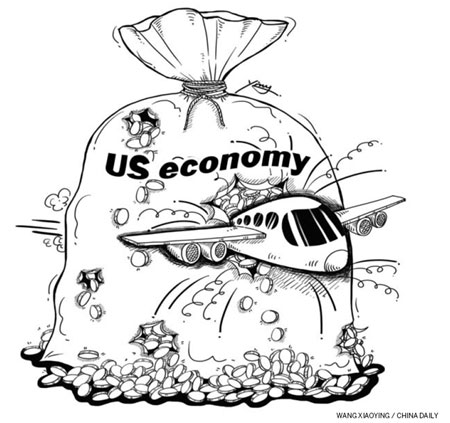
Ten years after the Sept 11, 2001, terrorist attacks on the United States, it is time to look back.
The tragic events - the crashing of two passenger jets hijacked by Al-Qaida terrorists into the World Trade Center, the collapse of the Twin Towers, the crashing of a third plane into the Pentagon, and the failed effort to crash a fourth - continue to retain a powerful hold on public consciousness.
We all remember what we were doing on 9/11, when nearly 3,000 people lost their lives. It was a day that changed the US, and the course of history, in a major way - but not for the better.
Ten years on, Americans are united in remembrance, but deeply divided over US economic and security policies. Most believe terrorists continue to have the ability to launch another major attack on the US and that the wars in Iraq and Afghanistan have increased the risk of terrorism in the US.
Considering the huge costs of the wars, these perceptions should make us pause.
According to a recent CNN poll, the majority of Americans believe that the most important national issue is economy (60 percent), the federal budget deficit (16 percent), and health care (9 percent). Only a fraction believes that the nation's most pressing issue is Iraq, Afghanistan or Libya (5 percent) - or terrorism (3 percent).
After the strong growth of the late 1990s, the technology revolution, and the budget surplus of former US president Bill Clinton's second-term, America was relatively well positioned for the burden of aging demographics and dependency ratios. But these prospects were undermined by the two terms of George W. Bush as US president and 9/11.
By the eve of President Barack Obama's inauguration, the deficit for fiscal year 2009, which began over three months before, had reached $1.4 trillion. At 10 percent of America's GDP, it was the largest deficit relative to the economy since the end of World War II. And if current policies remain in place, US deficits will hover near $1 trillion a year for the next decade.
The events and policies that pushed deficits to these high levels in the short term were, for the most part, not of Obama's making.
The effects of the worst recession since the Great Depression, and the costs of policy actions to fight it, certainly contribute to the diminished prospects of the US economy. But it is the Bush tax cuts and the deficit-financed wars in Iraq and Afghanistan that will account for nearly half of the $20 trillion debt that the US will owe by 2019.
In turn, the stimulus law and financial bailouts will account for less than 10 percent of the debt at that time. In effect, the tax cuts accounted for more than 44 percent of the total.
 New type of urbanization is in the details

Copyright 1995 - . All rights reserved. The content (including but not limited to text, photo, multimedia information, etc) published in this site belongs to China Daily Information Co (CDIC). Without written authorization from CDIC, such content shall not be republished or used in any form. Note: Browsers with 1024*768 or higher resolution are suggested for this site.
License for publishing multimedia online 0108263 Registration Number: 130349