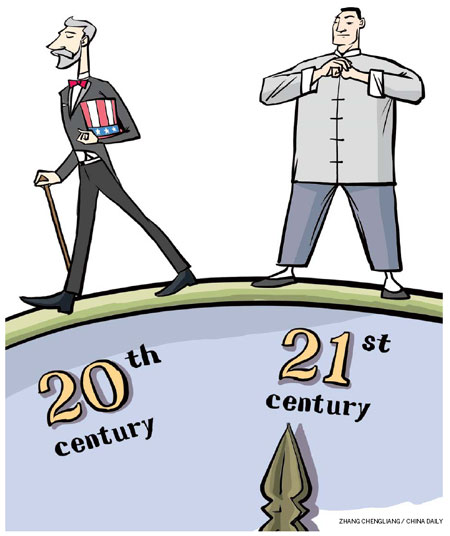
China's approach transcends the world of hard and soft power
When the American publishing magnate Henry R. Luce (1898-1967) announced 70 years ago the beginning of the "American century", he anticipated the US preeminence that followed World War II but he overestimated the duration of Pax Americana. Ironically, Luce who spent 15 years of his early life in China, would have been also very much at home in the 21st century where globalization increasingly rhymes with Sinicization and less and less with Americanization.
The contrast between the erosion of American power and China's ascension appeared vividly when US Vice-President Joe Biden was obliged during his recent visit to China to address the concerns of the Chinese people who are "skeptical about America's future prospects" - the wording used in his Chengdu speech - and had to repeat three weeks after the US Congress' acrimonious debate over the debt limit and the subsequent downgrading of the American credit rating by Standard & Poor's that the "US, which has never defaulted, will never default".
Obviously, Biden's defensive rhetoric could not hide the long-term problems of a country that has become sadly paralyzed by a parochial and short-sighted political establishment, unable to tackle debt addiction and to solve the contradictions between an overstretched military and the considerable financial interests of the military-industrial complex. While the world increasingly questions Washington's reliability, Beijing's credibility is on the rise and, in the eyes of many analysts, China's prudence balances America's irresponsibility.
China's renewal is not only super rapid quantitative progress but it is also defined by a rising qualitative global influence. One easily notices the signs of China's Westernization but China's embrace of modernity is also synonymous with the Sinicization of the global village. Apt to project a Chinese global narrative through increasingly sophisticated media, promoting Mandarin in more than 300 Confucius Institutes all over the world, attracting more and more foreign students in its universities, relying on opinion leaders such as Zhang Weiwei or Eric X. Li who are equally at ease in the West and in the Sinosphere, having highly competent experts in strategic international positions - Zhu Min, the new deputy managing director of the International Monetary Fund, or Justin Yifu Lin, the senior vice-president at the World Bank - China is rapidly strengthening its soft power.
After the work of US scholar Joseph Nye, it is common to limit the debate on national comprehensive strength to hard and soft power whose combination would supposedly form a "smart power". However, the patterns of Beijing's transformation invite the analyst to enlarge the reflections and to consider a third dimension of power, "subtle power", which is, to a certain extent, the application of some of China's highest philosophical principles in the field of strategy.
Less spectacular than hard power, more intangible than soft power, subtle power aims to shape a context that maximizes the effectiveness of the two traditional dimensions of power. While hard power acts directly, including by force, to impose itself, and while soft power attracts and cooperates, subtle power sets the environment in which hard and soft power can produce optimal effects.
The extraordinary Chinese ability to contextualize prepares the country's top decision-makers to have a holistic approach to world affairs that should not be interpreted as a refusal to take a clear position or responsibility on any singular question but should be understood as the prudence to carefully consider how actions on one particular issue may affect the entire equilibrium of the system. While hard and soft power analyze and target the almost endless individual components of the global power game, subtle power comprehends synthetically their interactions.
Subtle power's efficacy lies in the permanent interplay of five elements. First, it attributes a very high value to non-confrontation. Beijing's aptitude to implement an active multidirectional diplomacy and to avoid unnecessary opposition not only provides opportunities to satisfy the needs of China's development but elevates the country's status. Being able, for example, to maintain good relations with both Iran and Israel, or with both Teheran and Riyadh, Beijing is increasingly perceived in the Middle East as a factor of stability and a powerbroker.
Second, subtle power is associated whenever possible with non-interference. On its west, China neighbors Kyrgyzstan and Tajikistan, two relatively small countries, but Beijing does not try to impose on these new states any macro-economic guidance or a political roadmap. While Afghanistan and China's Xinjiang share 76 km of border, it is the US and NATO that are trapped in the Afghan quagmire.
 New type of urbanization is in the details

Copyright 1995 - . All rights reserved. The content (including but not limited to text, photo, multimedia information, etc) published in this site belongs to China Daily Information Co (CDIC). Without written authorization from CDIC, such content shall not be republished or used in any form. Note: Browsers with 1024*768 or higher resolution are suggested for this site.
License for publishing multimedia online 0108263 Registration Number: 130349