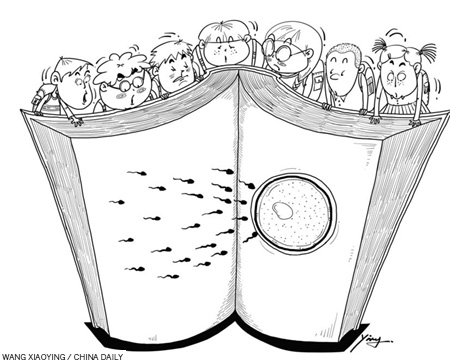
Sex education, especially sex education for primary school students, may come as a shock to many older Chinese who grew up in different times.
But, whether we like it or not, recent years have seen a dramatic increase in premarital sex, and unwanted pregnancies and abortions among young girls. And precisely for that reason sex education classes, complete with graphic drawings of sexual organs, will be introduced to a primary school in Beijing from this session on an experimental basis.
It is imperative that steps be taken to reduce the consequences of sexual activities among youngsters without proper knowledge. Medical clinics in China perform an estimated 13 million abortions a year. The actual number may be higher if we consider abortions performed in unregistered medical clinics and the fact that about 10 million abortion-inducing pills are sold every year.
The main reason why there has been a massive increase in the number of abortions is deceptively simple: Many people lack even the basic knowledge to prevent unwanted pregnancies. Perhaps this is what prompted Li Ying, a professor at Peking University, to say that young people need to acquire better knowledge about sex.
A recent government report says nearly two-thirds of the abortions in the country's hospitals are performed on single women aged between 20 and 29. A government official familiar with this area quoted almost 50 percent of the women who underwent abortions as having said they did not use contraceptives.
It seems that in terms of preventing abortions and unwanted pregnancies, China can learn something from other countries. In countries like the United States, Britain, Germany, Japan and Singapore, all schools have sex education courses which begin from the early grades, even in primary schools.
Some may argue that despite sex education being mandatory in US schools, abortions and unwanted pregnancies among American teenagers is still high. A Guttmacher Institute's survey shows that the abortion rate among 15-to-17-year-old American girls was 11.3 per 1,000 between 2000 and 2008, while a Family Research Council study shows the rate of abortion among unmarried women who cohabit is 52 per 1,000. But people need to realize that not ignorance about sex education but people's (especially youngsters') attitude toward sex is to blame for that. Plus, culture plays a big role in people's attitude toward sex.
Sex education in schools doesn't necessarily mean encouraging "sexual liberation". In China, where people are relatively conservative about sex, introducing sex education in schools in the early grades will help youngsters avoid unsafe sex rather than encourage them to have sex.
Every generation believes it "invented" sex, because the preceding generations did not tell them the facts about sexual activity and how to engage in it responsibly. Sexual activity and sexual feelings are a pervasive part of human experience. A survey conducted some years ago found it is not true that men always think about sex, though they think about it often. As for women, one need only read Nancy Friday's My Secret Garden, in which she has collected the typical sexual fantasies of a large number of women to show that sex is a central feature of women's world, too.
Therefore, humans do not have sex just for procreation. Sex serves multiple purposes, including personal pleasure, social bonding - as seen among live-in partners and spouses - and procreation.
Children and teenagers nowadays see images and stories about romance and sex in the media almost every day. They talk with friends or use the Internet to get information on sex. But the information they get may not be wholesome or accurate.
Avoiding discussions on sex won't prevent young people from taking interest in or having sex. It will only force them to get information from other sources which could be misleading and even dangerous, and could lead to unwanted pregnancies or sexually transmitted diseases.
Sensitive teachers imparting knowledge about sex to children, especially teenagers, will consider their age. Everything is not appropriate at every age. But when it comes to older teens, the topics could include the physical mechanics of sex or "what sex is", the nature of sexual attraction, sexual feelings and sexual pleasure, various approaches to values related to sex, sexually transmissible diseases and how to prevent them, safe sex practices, sexual preferences, how to say "no" to sex and how to accept a "no", and actions to take if one becomes pregnant.
As a necessary element of human life, it is only appropriate that sex - like other aspects of our lives - be dealt with frankly and appropriately in the educational process. It is true that primary school children are too young to experience sex. It is also true that they may not be ready for some kinds of information. But preparing them for the future is essential for healthy development and responsible use of this human faculty.
The author is a Canadian teacher living in Beijing.
(China Daily 09/02/2011 page9)
 New type of urbanization is in the details

Copyright 1995 - . All rights reserved. The content (including but not limited to text, photo, multimedia information, etc) published in this site belongs to China Daily Information Co (CDIC). Without written authorization from CDIC, such content shall not be republished or used in any form. Note: Browsers with 1024*768 or higher resolution are suggested for this site.
License for publishing multimedia online 0108263 Registration Number: 130349