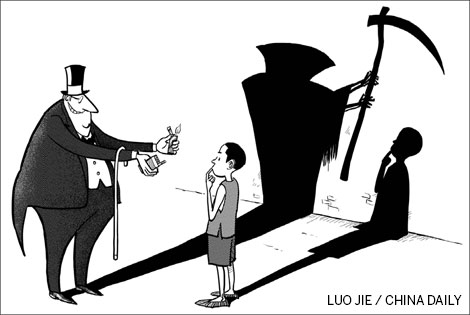
Facing greater restrictions in the United States and other industrialized countries, transnational tobacco companies have intensified the marketing of their products in developing countries, particularly among women and adolescents.
For the past several years, multinationals such as Philip Morris, RJ Reynolds and British-American Tobacco have been expanding rapidly in Eastern Europe, Asia, Africa and Latin America.
While the percentage of smokers in some industrialized countries is falling by about 1 percent a year, in developing countries it is increasing by about 3 percent a year. It is estimated that if this trend continues for the next 30 years, smoking-related diseases will kill up to 7 million people a year in developing countries.
Tobacco-related deaths can only add to the inequities in health care of ethnic and poor populations. According to data from the Bureau of Census, US Department of Commerce, the number of Latino smoking youth in the United States will increase three times by 2020.
Since the early 1980s, US trade officials, with the help of the Office of the US Trade Representative, have led a sustained campaign to open markets in Asian countries and regions such as Japan, South Korea and Thailand. Their move has prompted the Asia Pacific Association for the Control of Tobacco to protest strongly against the "invasion of their countries" by US companies, which especially target Asian women and children. The association has complained against the strong-arm tactics used by US government officials, too.
In fact, a US General Accounting Office report has established that "US policy and programs for assisting the export of tobacco and tobacco products work at cross purposes to US health policy initiatives, both domestically and internationally".
Several studies have shown that in the poorest households in developing countries, 10 percent or more of the total household expenditure is on tobacco. As a result, there is less money to spend on necessities such as food, education and health care. This increases malnutrition, illiteracy and the chances of premature death.
In China, tobacco companies have been moving steadily inland with intense promotional campaigns. It is estimated that more than 350 million of the world's 1.71 billion smokers are in China, where lung cancer cases have been increasing by 4.75 percent a year.
The Chinese government is facing a dilemma in promoting anti-tobacco policies, because the earnings of State-run monopoly tobacco companies form a good part of its revenue. Research scholars with the School of Public Health at the University of California, however, say that increasing tobacco tax by 15 US cents (about 1 yuan) per cigarette pack could save more than 13 million lives and generate $9.5 billion in revenue for the Chinese government.
Lured by financial gains from growing tobacco, millions of hectares in China are under tobacco cultivation. Gains from the sale of tobacco may be short term, because the costs of treating lung cancer and other tobacco-related diseases far exceed the profits. According to experts, the extra cost worldwide could be up to $200 billion a year, one-third of which is incurred by developing countries.
While anti-smoking efforts gather momentum in the US, they are far less effective in developing countries. Such countries' policies will not be as effective as they should be unless transnational tobacco companies are made to curtail their aggressive advertisements.
Many countries in Asia and Latin America are conducting health-education campaigns and have passed legislation to control smoking. Up to now, several countries across the world have enacted legislation to curb tobacco consumption. Although generally such legislation has been passed at the national level, in the US, Canada and several countries in Latin America and the Caribbean, provinces or local bodies are enacting these laws.
Despite increasing condemnation by public health officials and the World Health Organization, tobacco companies, especially multinationals, continue their indiscriminate and aggressive promotions in developing countries at the cost of human lives. As things stand now, only a multidisciplinary strategy that includes education, taxation, legislation and regulation of trade practices of transnational corporations can control this pandemic.
The author is an international public health consultant.
(China Daily 08/11/2011 page9)
 New type of urbanization is in the details

Copyright 1995 - . All rights reserved. The content (including but not limited to text, photo, multimedia information, etc) published in this site belongs to China Daily Information Co (CDIC). Without written authorization from CDIC, such content shall not be republished or used in any form. Note: Browsers with 1024*768 or higher resolution are suggested for this site.
License for publishing multimedia online 0108263 Registration Number: 130349