Members should first agree consensus on least developed countries' agenda and then discuss US-proposed 'plus' issues
At the end of April 2011, all WTO members came to recognize that there was no hope of concluding the negotiations of the Doha development round by the end of this year. As a confidence booster for the continuation of negotiations on "the single undertaking" of all issues for the round next year, members agreed in late May to get a package of issues agreed for the benefit of the least developed countries (LDCs), as an early harvest for adoption in December by the Eighth WTO Ministerial Conference (MC8).
To achieve that objective, the LDCs put it clearly at the meetings in May and on June 22 of the WTO Trade Negotiating Committee (TNC), the watchdog body of this round of negotiations, that the LDCs were only requesting four elements in such a package.
These are: That duty-free and quota-free (DFQF) market access be accorded by developed members and those developing countries that are in a position to do so; the simplification of the preferential rules of origin for the smooth implementation of the DFQF treatment; a waiver by the developed members of the most-favored-nation (MFN) principle in providing priority market access for services from the LDCs; and the expeditious and substantial reduction of trade-distorting cotton subsidies.
Almost all the developing members, including Brazil, China, India and other so-called emerging economies, demonstrated their full sympathy to the LDCs and endorsed these reasonable demands. Regrettably, the United States put on the table, in their own interests, quite a few additional LDC issues that contain many substantive and divisive elements subject to further negotiations prior to December, making the process much more difficult than anticipated.
According to delegations of WTO members in Geneva, numerous consultations have taken place since the May TNC meeting among members, as well as between members and the WTO Director-General Pascal Lamy, in order to fix the elements of the LDC "plus" package strongly advocated by the US.
However, much of the time and energy consumed by the consultations have been devoted to the "plus" issues of interest to the developed members, rather than to issues raised by the LDCs. The cart has thus been put before the horse.
Obviously, none of the issues proposed by the US or any other developed member for the "plus" package will be easy to reach agreement on before MC8, be it trade facilitation, nontariff barriers, environmental goods and services, fishery and horizontal subsidies, or any of the others. As little substantive progress has been obtained on these issues during negotiations over the past decade, it is daydreaming to expect that an agreement will be reached on any of them before December, let alone when they are pooled together as a package,
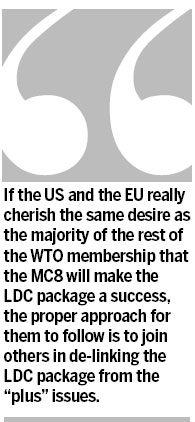
Honestly speaking, if the US and the EU really cherish the same desire as the majority of the rest of the WTO membership that the MC8 will make the LDC package a success, the proper approach for them to follow is to join others in de-linking the LDC package from the "plus" issues, build a consensus with others on the former first and put it to the ministers for official approval. Members can then proceed with the "plus" issues as the next step if time permits.
To have the process the other way round, to discuss the "plus" issues first and take reaching agreement on them as the condition attached to the LDC package, will simply kill the LDC package and substantially devalue the MC8, even though a work program for "the single undertaking" negotiations could be adopted at the Conference as planned. The credibility of the multilateral trading system will be further damaged, which will be of no benefit to any members of the WTO, including the US.
Members must therefore make every effort to avoid such frustrating consequences from coming into being.
The author of this article is vice-chairman of China Society for WTO Studies and senior adviser to the Shanghai WTO Affairs Consultation Center.
China Forum
 New type of urbanization is in the details

Copyright 1995 - . All rights reserved. The content (including but not limited to text, photo, multimedia information, etc) published in this site belongs to China Daily Information Co (CDIC). Without written authorization from CDIC, such content shall not be republished or used in any form. Note: Browsers with 1024*768 or higher resolution are suggested for this site.
License for publishing multimedia online 0108263 Registration Number: 130349