But it needs better governance, higher public sector efficiency, and has to review central-local government economic relations
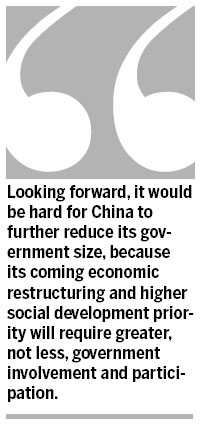
China has adopted the 12th Five-Year Plan (2011-2015) to address its existing and emerging development challenges that include making the economic growth pattern more sustainable through economic restructuring and rebalancing. This commits the government to an active role in the country's next phase of development.
China's economy has rebounded strongly from the global financial crisis with a highly impressive 10.3 percent growth in 2010. The country has replaced Japan as the world's second largest economy, too. The Chinese government no doubt has performed well in terms of implementing economic reform and ensuring continuous development. Its past economic records speak volumes of the role it has played.
Notwithstanding this, many Chinese intellectuals and economists today are taking stock of China's previous development strategies. They are debating about what should now be the "proper role" of the government in the country's development. Has the government's participation in economic development been "optimal"? Could it be better? The ongoing debate involves a lot of "normative" (subjective) issues, and it is not easy to come up with an objective answer.
To begin with, all economies are mixed, with the government and market both being involved in their respective economic and social activities. Most people would agree that there are certain things that the state should do and can do better - and there are things that the market should do and can do better.
But there are many things that fall between these two extremes, with many people disagreeing on which activity should best belong to the state and which to the market.
In short, there is simply no such thing as an "optimal mix" of the two. Much depends on the political and social structure of a particular economy and its ideological orientation. Furthermore, the "mix" itself is not fixed but dynamic and changing over time.
Western capitalist economies used to subscribe to Adam Smith's doctrine of the "Invisible Hand" that called for minimum state intervention in the economy. Subsequently, the Great Depression of 1932 gave rise to the "Keynesian Revolution", which required the government to undertake active macroeconomic management to reduce inflation and maintain full employment.
From 1980 onward, Western governments, especially the Ronald Reagan administration in the United States and Margaret Thatcher's Conservative government in the United Kingdom, gradually shifted to the right by advocating "small government" and "bigger role for the private sector". Such is the origin of the so-called "Washington Consensus", which places paramount importance on the market. The "Chicago school of economics", with its advocacy on monetarism, efficient market hypothesis and rational expectations provided further intellectual support to this kind of thinking.
 New type of urbanization is in the details

Copyright 1995 - . All rights reserved. The content (including but not limited to text, photo, multimedia information, etc) published in this site belongs to China Daily Information Co (CDIC). Without written authorization from CDIC, such content shall not be republished or used in any form. Note: Browsers with 1024*768 or higher resolution are suggested for this site.
License for publishing multimedia online 0108263 Registration Number: 130349