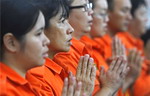
We are passing through the Global Action Week (May 2-8), which is observed annually across the world to highlight the importance of "education for all".
Let us use this important occasion to take a closer look at this year's theme: Gender equality in education. Education leads to profound life-changing choices. But even in this advanced age, more than 39 million girls in the world do not have access to primary-level education and are thus denied this fundamental human right.
Inequality in education cripples the lives of millions of girls and women around the world. While women's rights have made significant progress, women are still second-rate citizens in a lot of countries. According to United Nations Population Fund (UNFPA) figures, women perform 66 percent of the world's work and help produce 50 percent of the global food output but earn less than 10 percent of the global income and own just 1 percent of the global property stock. Although the gender gap in education has narrowed over the past decade, girls are still at a disadvantage, especially when it comes to higher secondary education. Women in South Asia, for example, have only half as many years of education as men, and the female enrolment rate at the higher secondary level is two-thirds that of males.
The situation in China, however, is a lot more encouraging. The average years of education for women in 2008 was 7.3, only one year less than that of men. The gender parity index at the higher secondary level in 2009 was about 0.89, meaning that girls' participation at this level of education was comparable to that of boys.
Latest data of UN Educational, Scientific and Cultural Organization (UNESCO) show that in South and West Asia on average only one in two women can read and write. In stark contrast, about seven out of 10 men can do so. In East Asia and the Pacific, a staggering 74.5 million women are illiterate, representing 71 percent of the total 105 million illiterate adults.
China has made remarkable progress in literacy in the last 20 years. Its female illiteracy rate (15 year-old and above) dropped from more than 30 percent in 1990 to 11.52 percent in 2008, which has greatly contributed to the reduced number of illiterates, especially among women, in the Asia-Pacific region.
These issues are at the heart of UNESCO's mission, which is promoting quality education for all. This includes supporting quality education from early childhood through to primary and secondary levels, and up to the tertiary and vocational training levels. Achieving equality in primary and secondary education is critical to overcoming development challenges and structural discrimination. Education is critical to laying the foundation of gender equality and the empowerment of women. Even today, the fate of most women in many developing countries is to get married, become mothers when still very young and then tend to the family. This starts during adolescence when many girls are busy looking after their siblings, cooking and cleaning at home, and attending to other household chores, while their chances of going to school or receiving proper medical care are much lower than their male counterparts.
 New type of urbanization is in the details

Copyright 1995 - . All rights reserved. The content (including but not limited to text, photo, multimedia information, etc) published in this site belongs to China Daily Information Co (CDIC). Without written authorization from CDIC, such content shall not be republished or used in any form. Note: Browsers with 1024*768 or higher resolution are suggested for this site.
License for publishing multimedia online 0108263 Registration Number: 130349