


Home> News
Daigoji Temple artifacts on show in Shanghai
Updated: 2016-07-05
( chinadaily.com.cn )
 |
|
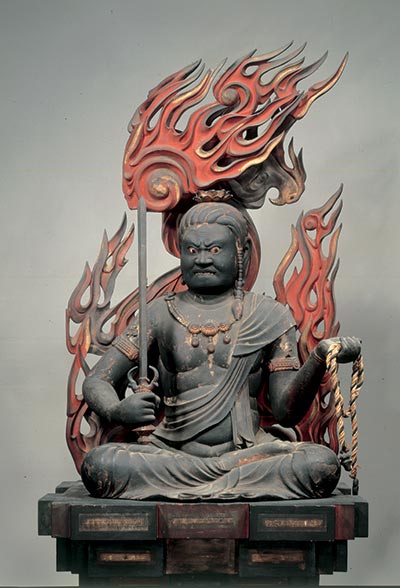
An exhibition at Shanghai Museum offers a rare view of Buddhism arts from Japan. The Beauty of Mantra: Arts in the Collection of Daigoji Temple is running through July 10. [Photo provided to China Daily] |
The 64 exhibits, six of which are recognized as Japan's "national treasure", are on show out of their home country for the second time, following an exhibition in Germany. They will move on to be shown in Xi'an, Shaanxi province.
Daigoji Temple sits in the southeastern suburb of Kyoto, the ancient capital of Japan. It was founded in 874; the origin was the monk Kukai's going to China and studying Vajrayana, or Esoteric Buddhism, in 804. Daigoji Temple went on the list of UNESCO's World Cultural Heritage in 1994.
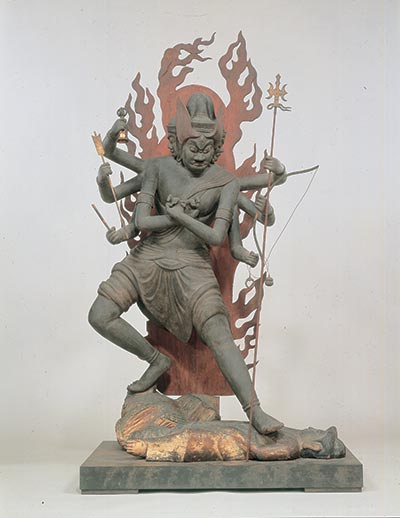
Aside from Buddhas and Bodhisattvas, a third type of deity is prominent in Esoteric Buddhism. That is the Wisdom King, whose statues are a major highlight of the show.
In contrast to the peaceful or blissful expressions often seen on Buddha statues, the Wisdom Kings are viewed as the guardians of Buddhism, and wrathful manifestations of Buddha. These statues sometimes have several faces and multiple limbs, each holding weapons and sometimes adorned with skulls, ropes and wreaths of fire.
 |
|
An exhibition at Shanghai Museum offers a rare view of Buddhism arts from Japan. The Beauty of Mantra: Arts in the Collection of Daigoji Temple is running through July 10. [Photo provided to China Daily] |
"Here we find the same phenomenon," he said. "Since Esoteric Buddhism entered Japan, the Buddhism art gradually localized."
Even though China and Japan share a lot in the ethnic traces and cultural heritage, distinctive differences could be found in the hairstyle and wardrobe, as well as facial features of the Buddha statues and portraits from Daigoji Temple.
The exhibition consists of three parts. The first shows the origin of Daigoji Temple, by presenting the history, from the establishment to the development and continuation of the temple. The second features the rituals and sacred imageries, where there are a large number of statues, ritual items, paintings and scriptures. The third features the Artistic Life of Daigoji Temple.
IF YOU GO
9 am-5 pm, through July 10. Shanghai Museum, 201 Renmin Avenue, Huangpu district, Shanghai. 021-6327-3500.
Related:
