 |
|
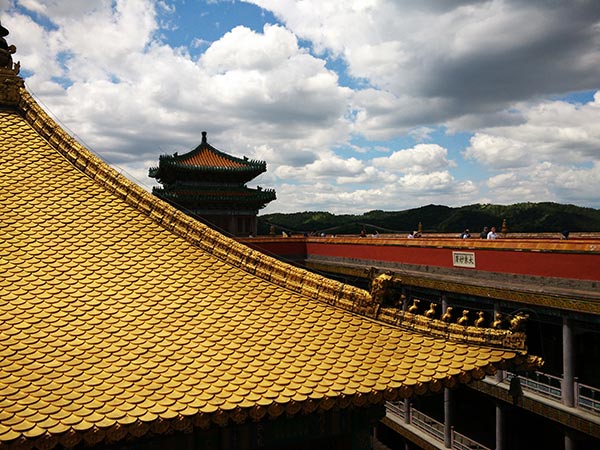
The main renovation project on the Temple of Potalaka in Chengde, Hebei province, was completed on Saturday. The mountain resort and its temples form the largest surviving royal garden and temple complex in the world. [Photo by Wang Kaihao/China Daily] |
A ceremony to mark the restoration of the main buildings in the Putuo Zongsheng Temple, commonly known as the Temple of Potalaka, in Chengde, Hebei province, was held on June 11, National Cultural Heritage Day.
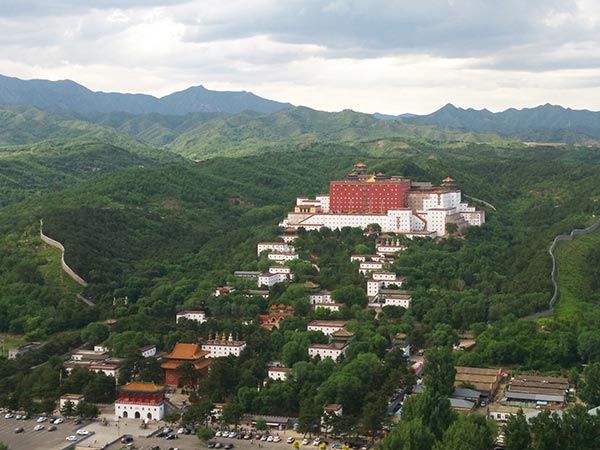
The Temple of Potalaka was built in 1771 loosely modeled on the Potala Palace in Lhasa, the capital of the Tibet autonomous region.
It is the biggest among the 12 satellite temples around the Chengde Mountain Resort, which was considered China's "Summer Capital" in the Qing Dynasty (1644-1911) as several emperors spent their summers there.
The resort and its temples were included in UNESCO's World Heritage list in 1994, and they form the largest surviving royal garden and temple complex in the world.
The mountain resort alone covers 564 hectares, an area roughly twice the size of the Summer Palace in Beijing.
While the structures were taken care of by the Qing court before the mid-19th century, later they were dependent on lamas. Then, the area was ravaged by warlords and the Japanese invaders.
Systematic renovation of these structures began only in the late 1970s.
According to Zhang Lifang, the director of the Hebei Provincial Administration of Cultural Heritage, major restoration of the mountain resort and the temples began in 2010.
The project, which included 105 small units cost 600 million yuan ($92 million) then.
The latest restoration of the Temple of Potalaka covers 55 structures, which Sun Yingzhuo, an expert from the Hebei Ancient Construction Research Institutions, says is a breakthrough as the previous restorations only focused on the bigger structures in the temple.
 |
|
[Photo provided to China Daily] |
Sun, who was in charge of the restoration, says restoring the roof was the most difficult part of the process as there are very few similar structures in China, and thus there was a need for continuous experimentation.
"Drainage was another key aspect of the project," says Sun.
"Many structures from the Qing Dynasty have not been repaired for a long time, and many of them have flat roofs built in the Tibetan style. So, if the drainage system does not work well, it can be a potential hazard."
Still, he says, as long as the original drainage works and needs only partial restoration, no modern drainage will be introduced.
Improvements in the security and fire-alarm systems have also been included in the renovation.
Though the main restoration of the structures has been completed, he says, some follow-up auxiliary projects like the indoor decorative paintings will continue until the end of this year.
Tan Pingchuan, who leads the painting restoration, says: "We don't aim to give them a new look.
"The vestiges of previous restorations is also a part of history and need to be maintained. We will reinforce and clean the paintings, but we won't draw something new."
The restoration also means that a lot of data and files have been created on these World Heritage sites, says Lu Qiong, the deputy head of the cultural heritage protection office under the State Administration of Cultural Heritage.
"These files will form the basis for further protection," she says.
"A long-term mechanism of preventive protection is to be set up to enhance daily maintenance under more rigid supervision."
Related:

Copyright 1995 - . All rights reserved. The content (including but not limited to text, photo, multimedia information, etc) published in this site belongs to China Daily Information Co (CDIC). Without written authorization from CDIC, such content shall not be republished or used in any form. Note: Browsers with 1024*768 or higher resolution are suggested for this site.
License for publishing multimedia online 0108263 Registration Number: 130349 














 Raymond Zhou:
 Pauline D Loh:
 Hot Pot
 Eco China
 China Dream
 China Face