 |
|
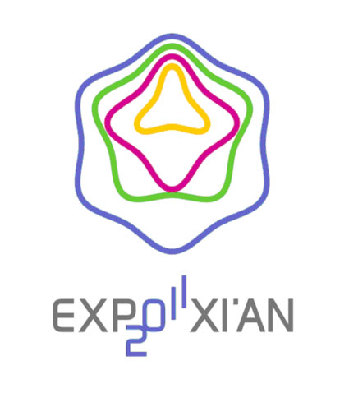
The emblem of the International Horticultural Exposition Xi'an
|
 |
|
The emblem of the International Horticultural Exposition Xi'an composed of lines
|
 |
|
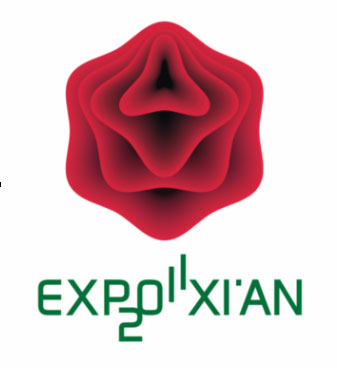
The monochromatic emblem of the International Horticultural Exposition Xi'an
|
The emblem of the International Horticultural Exposition Xi'an is the “Chang'an Flower”, which names after a poem “Riding on the crest of success, seeing all the flowers in Chang'an.”
The design stems from the Classic of the Virtue of the Path and the Power: “The Tao produced One; One produced Two; Two produced Three; and Three produced All things.” The emblem takes the shape of a flower composed of petals arranged in ascending order, from the triangle of the innermost layer to the hexagon of the outer layer, forming an auspicious oriental flower seal. The emblem was designed by Chen Shaohua, a well-known graphic designer from Xi'an, who also designed the emblem of the 2008 Beijing Olympics and Chinese New Year Zodiac stamps. The emblem can be interpreted as follows: THREE for the seeds of all nature, lying in an auspicious flower; FOUR for the corners of the land, propping up the vault of heaven; FIVE for the foliage from the trees, shielding the flourishing land; and SIX for running water, nurturing all life on the planet.
Among the layers of the flower, the triangle at the center of the pattern takes the shape of the Chinese character “人” (people) symbolizing people first and foremost, and representing civilization, responsibility, and reason; the rectangle of the second layer represents the ancient city of Xi'an, metaphorically referring to “Chang'an City” (the capital of China during the Tang Dynasty) and symbolizing a harmonious living environment; the pentagon of the third layer, similar to a five-petalled flower, the most common in nature, represents the five elements of metal, wood, water, fire, and earth, namely all the things in nature; the hexagon of the outer layer, in the shape of a snowflake and showing the appearance of running water, symbolizes tolerant nature. The ascending order of the petals, from the triangle to the hexagon, signifies the harmonious co-existence of humans, cities and nature, which interacts harmoniously with the theme of this exposition: Eternal peace & harmony between nature & mankind, nurturing the future earth.
More emblems of previous expositions
The emblem of the International Horticultural Exposition Kunming, China in 1999
 |
|
The emblem of the International Horticultural Exposition Kunming, China in 1999
|
The movement of nebula, atmosphere, and wind renders the blossoms of life, symbolizing the harmonious co-existence between man and nature.
The emblem of the International Horticultural Exposition Shenyang, China in 2006:
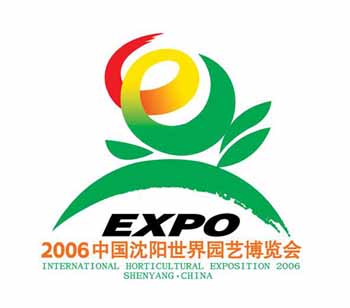 |
| The emblem of the International Horticultural Exposition Shenyang, China in 2006 |
The iron flower petals splattered from roses, the earth and machine tools form the image of a rose in full bloom. The rose is the city flower of Shenyang; its color transition from red to green implies that Shenyang, once a heavily polluted city, has gradually developed into an environmental-friendly eco-city; lastly, the image of the earth refers to the world. This emblem is a microcosm of the harmonious coexistence between man and nature.
The emblem of the World Expo 2010 Shanghai China
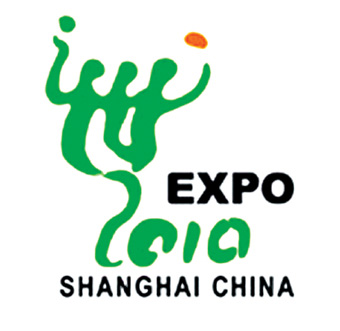 |
| The emblem of the World Expo 2010 Shanghai China |
Interpretation: The Shanghai World Expo emblem was created from the shape of the Chinese calligraphic character“世”(world). It depicts the image of three people-you, him/her, and me- joined hand-in-hand. It also symbolizes a happy and prosperous family from a microscopic view and the pursuit of a harmonious life from a macroscopic view. The emblem expresses the concept of “understanding, communication, gathering and cooperation" and the aspirations of people first and foremost.



 Xi'an Expo 2011