|
 |
|
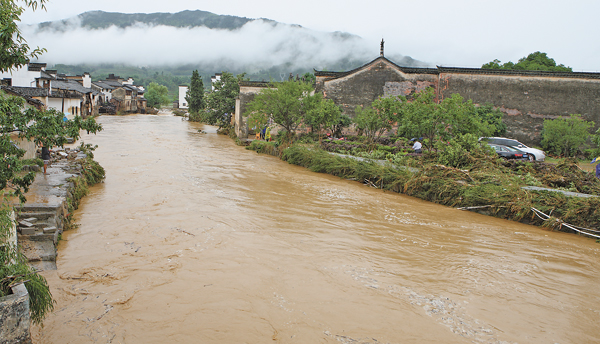
The Zhongchuan River narrows at the point where Huanxiu Bridge stands. [Photo By Zhang Jianping/For China Daily]
|
Legend has it that the bridge was built by a local woman whose husband died when doing business far from home. She made up her mind to save every penny to build a bridge so that it would be easier for local residents to connect to the outside world.
The bridge was a vital thoroughfare for Hui businessmen, who were the major drivers of Chinese commerce in ancient times. Today, it is still an important passageway for villagers.
"Without the bridge, they would have to detour by a far away road in the mountains," says local resident Wang Chunxia.
More than that, the bridge is a gathering place for the local community. "We have grown attached to it," Wang says. "Since I was a child, it has been a place where we hang out and chat. For the young ones, this is the place to meet and fall in love."
Hopefully, the bridge will be all these and more again, when it is restored by the end of November, says Hu Rongsun, director of Huangshan city bureau of cultural heritage. The rest of the bridge that could not be recovered will have to be replaced, he says.
"We are not in a hurry to get the stone components back from the water. Moving them now may cause possible damage. It would be better to start evacuating only when the whole restoration plan is ready," Hu says.
The restoration will follow the blueprint of the 100-year-old Wind Rain Bridge in Guizhou province, successfully restored in 2006 after local villagers salvaged parts after a destructive flood. "We will follow the original form strictly according to the archives, so that we will be able to 'restore the old as the old'," says Hu.
Experts from the Chinese Academy of Cultural Heritage have worked out a restoration plan, which will have to be authorized by the State Administration of Cultural Heritage before it is implemented in early October. The restoration is expected to take two months.
But, activists following the progress of the restoration are concerned. "My major concern is if all the original materials will be saved in the restoration process," says Zhang, the photographer. He says one of the major problems in architecture restorations in the Huizhou area is the casual replacement of the old by the new.
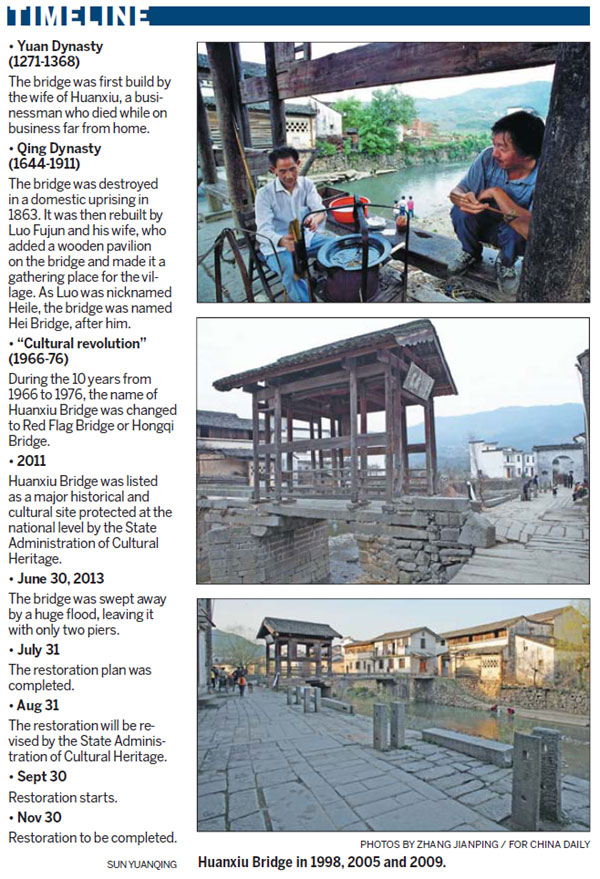
Huanxiu Bridge is built from a particular kind of granite that comes from the Huizhou area. The wooden benches have been polished smooth after having served for hundreds of years. The inscription that hung over the roof of the pavilion has recorded the three names the bridge used in times of Yuan Dynasty, Qing Dynasty (1644-1911) and the period during the "cultural revolution" (1966-76).
"All these are traces of time," Zhang says. "Some of them may have been broken or partially damaged, but they should still be repaired rather than be replaced. If new materials are used, then they must be of the same quality and from the same source."
Contact the writers at sun-yuanqing@chinadaily.com.cn and jibeibei@chinadaily.com.cn.
|