|
Huangshan city, in southern Anhui province, was not always known by this name. For millennia, the region around the fabled Huangshan, or Yellow Mountain – probably China's most famous peak – was known as 'Huizhou'. Today, mention of the name 'Huizhou' still conjures up romantic fascination among Chinese people.
Asked to elaborate, many will inevitably reference the Yellow Mountain's haunting natural beauty: the contorted pines and the strangely shaped boulders that dot its slopes, and the sea of clouds that turn surrounding mountain peaks into jagged islands.
But Huizhou – today's Huangshan city – has more to offer than the Yellow Mountain. To visit Huangshan city and not see the Yellow Mountain is inconceivable. But to leave, not having bathed in the region's hot springs, marveled at the ancient Daoist ritual sites atop Qiyun Mountain or sauntered along the banks of the Xin'an River, is a travesty.
Millions of tourists make pilgrimage to Huangshan city every year. Many stay only a few days, during which – if they rush – they can take in all the above marvels. But stay a bit longer and you'll find Huangshan has even more to offer.
Huangshan City's Huizhou culture is a national treasure, and is rightly recognized alongside China's Dunhuang Culture and Tibetan Culture as occupying a special place in the cultural legacy of the nation. Today, thanks to preservation work, much of the region's past treasures remain; travelers seeking to immerse themselves in history find few regions in China that have more to offer than Huangshan.
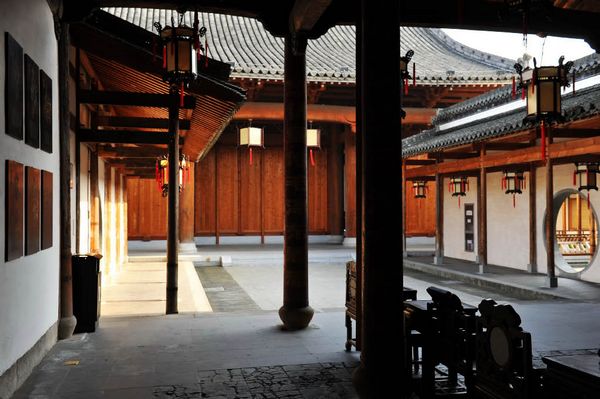 |
| A historical magistrate's office, recently restored. |
Ancient, but Not ruined
'Huangshan city' and 'Huizhou' are today used largely interchangeably, though the latter more often refers to the culture of the region. 'Huangshan' in Chinese actually means 'Yellow Mountain'. The name of the local municipality was changed in honor of the famous mountain several decades ago, ostensibly to encourage tourism. Today's Huangshan city consists of three districts – Tunxi, Huangshan and Huizhou – as well as four counties, namely Shexian, Xiuning, Yixian and Qimen. The Yellow Mountain Scenic Area itself also falls under the city's jurisdiction.
Huizhou traders were famous throughout ancient China for their commercial prowess. As they grew wealthy, local culture also grew richer. The most obvious manifestation of this legacy of wealth is visible in local architecture. Many marvelous dwellings of former times remain to this day. With their brilliant white walls, black-tiled roofs, memorial archways and ancestral halls, they stand in timeless tribute to the prosperity of former times.
Today, there are over 5,000 historical and cultural remains in the Huangshan city area, of which local architectural styles of old are just one fraction. Classical stone inscriptions are another. It's rare – even in China – to see such a high concentration of historically significant sites and cultural traditions.
|