|
A bright blue ceramic water flask unearthed from centuries of silt and used by traveling monks to wash their hands before prayer has become a clue for archeologists seeking the original canal bed. Porcelain craftsmen learned to make blue china as early as the Tang Dynasty (AD 618-907), using pigment derived from cobalt, which was mainly mined in today's region of Iran (Persia) and Iraq.
This water flask is Cambridge blue and the color is translucent because it was colored at a low temperature. Darker blue porcelains were not made until around the year 1200, when craftsmen learned how to fire porcelain at much higher temperatures, adding more layers and maturity to the color. The religious vessel dates back to the Tang Dynasty, when China was a cultural, economic and art center.
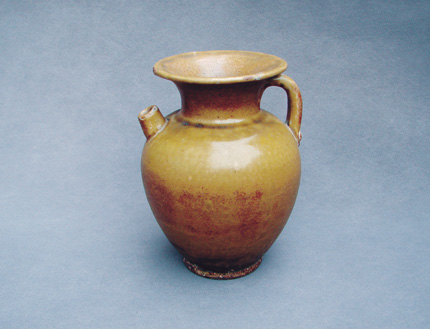 |
| Ceramic shards lead to discovery of canal |
Trade flourished in the east, as well as west along the Silk Road that went through Persia to the Mediterranean Sea. Tea, silk and porcelain were among the most important Chinese exports. Many such flasks were discovered in archeological sites in Suzhou and Huaibei, especially Huaibei’s Grand Canal of China, which is located in the north of Anhui province.
|