Public dancing holds us together, participants say
 |
|
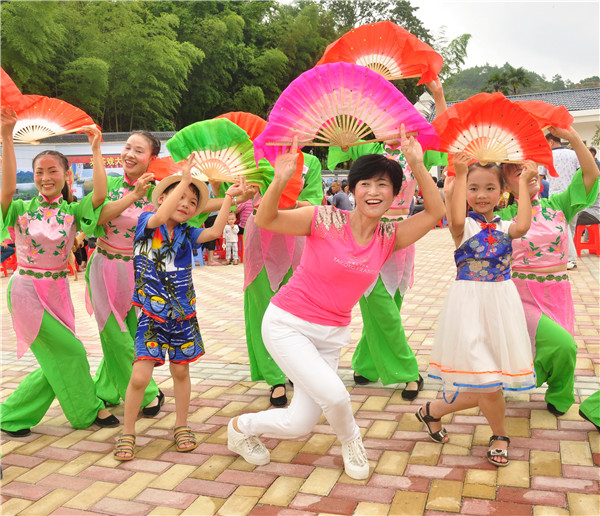
Some women and children practice a dance routine in Anyuan, Jiangxi province. [Photo by Zhong Zhijiang/For China Daily] |
In a 450-year-old ancestral temple in a village in East China's Jiangxi province, as dusk falls, a group of women begins what has become a daily ritual. In this hall in which villagers once paid respect to their ancestors, the women are practicing dance routines. Outside there is a relaxed air as adults who have been working in the nearby fields unwind while their children play and dogs scamper about.
At the same time in a spacious downtown square about 200 kilometers away in Changsha, capital of Hunan province, more than 1,000 dancers, mostly in their 50s and 60s, make the moves as music blares out from speakers.
From ancestral temples in villages to stadiums in cities, guangchangwu, or "square dancing", can be seen every day in thousands of China's public spaces. It is encouraged by the central government as grassroots entertainment in the same way that libraries and museums are promoted to build public cultural services.
For a decade, Li Nianqiu, 63, has taught dancing at He Long stadium in Changsha, where hundreds of practice every day. At first his lessons were unpaid, but now he is employed by the local government. He receives free training at college, learning how to organize large dance troupes and the use of big spaces, he says.
"Such dancing in the city began in this stadium. It's really good for society as a whole. For one thing, it means people who could otherwise be wasting their time gambling will go dancing instead. It keeps people fit, too."
Li says he does not need the salary because he owns a factory and several shops.
Those who love to dance-and many of them are retirees-are afforded not only public spaces to pursue their activity, but can also make use of rooms in cultural centers. Liu Hanbing, director of the cultural center at Tianxin district in Changsha, says she is much busier than she was a few years ago because of the number of dance competitions, and the center has to offer free lessons to the public, including calligraphy and music. The target group is retirees or children.
As cultural centers have mushroomed in Hunan, so have museums and libraries. Even at county level there will be two or three museums that serve different functions. The provincial government says Hunan has 109 museums and 129 cultural centers. From 2012 to 2013, it says, it spent about 15.7 billion yuan ($2.53 billion) on building museums, cultural centers and libraries in 122 counties.