Comments
  Print
Print  Mail
Mail  Large Medium Small
 |
|
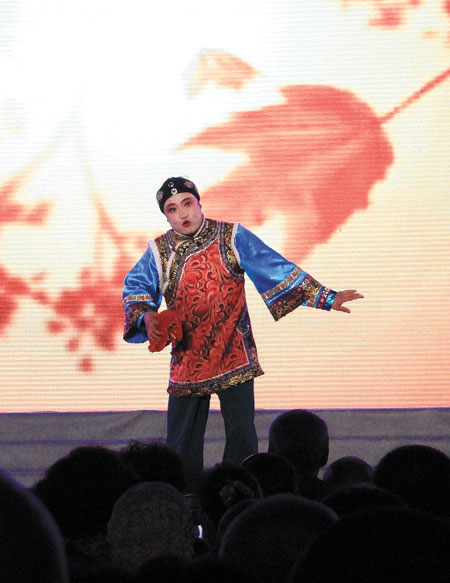
Photo by Wang Kaihao / China Daily |
"Men and women sing the same tone in errentai, which distinguishes itself from other operas. If a young boy begins to sing at a very young age, he will encounter difficulties after his voice breaks."
He says the best age to begin is upon graduation from junior high school.
Yang Cunwang, an errentai performer who started at an arts school in 2003, is one of the pioneers bringing this traditional opera to young people.
"There was a shortage of experienced young performers then," Yang says. "New generation almost had no channel to enter the circle of errentai."
A 2,000-square-meter yard is where more than 200 students at the school receive physical training. A classroom acts as their ballroom for rehearsals. Though the conditions are basic, Yang feels lucky this place was approved as a polytechnic school in 2011, meaning students' tuition is paid by the government. He claims this is the only polytechnic school that teaches errentai in Inner Mongolia.
"If students work hard enough, they can be enrolled by professional troupes after graduation," he says. "In such a society where young people are under heavy pressure to find a satisfactory job, it has been pretty good."
Student Zhang Jiaorong, 18, has to wake up everyday at 6 am, and only has a half-day rest each week, but she is optimistic about the future.
"It's like playing, and not as exhausting as people usually think," says Zhang who comes from Shanxi. "I don't think much about the historical responsibility, but I wish I can be lucky enough to become a professional."
Duan says the professional training is beneficial, with performers learning about other opera forms, elevating errentai into a higher level, but he worries some of the original flavor of the opera will be lost.
"Many performers from the younger generation who are graduating from school now, sing in Mandarin rather than our dialects," he says. "Though they still use dialects when addressing the spoken parts, it feels very strange when combining the two together."
Duan adds that performers also believe, in error, that the higher pitch they can sing, the better they will be, thanks to the influence of TV reality-singing shows.
"We can learn some voicing method from bel canto, but diverse styles are needed," he explains. That is why for years he has been calling for the development of different schools within errentai, just like Peking Opera.
"Artists, no matter how great they are, can only be half-qualified if they cannot make others follow their style. When old errentai artists die, their legacies should be immortal.
"Sadly, we haven't seen that promising situation," he sighs. "Some styles easily disappear."
|
|
|
| An opera legacy lives on | Tibetan folk art Batang Xianzi, a well-preserved tradition |




Copyright 1995 - . All rights reserved. The content (including but not limited to text, photo, multimedia information, etc) published in this site belongs to China Daily Information Co (CDIC). Without written authorization from CDIC, such content shall not be republished or used in any form. Note: Browsers with 1024*768 or higher resolution are suggested for this site.
License for publishing multimedia online 0108263 Registration Number: 20100000002731