

 Comments
  Print
Print  Mail
Mail  Large Medium Small
Words made up by netizens should not be overused in daily life: experts
Citing tradition, a team of experts has urged the public to use standard Chinese characters despite the popularity of Internet buzzwords.
A team of experts working with the Ministry of Education released a list of 8,105 of the most commonly known Chinese characters on Tuesday, categorized by frequency of use, in an effort to standardize the language and deter the use of newly coined terms on the Internet.
 |
|
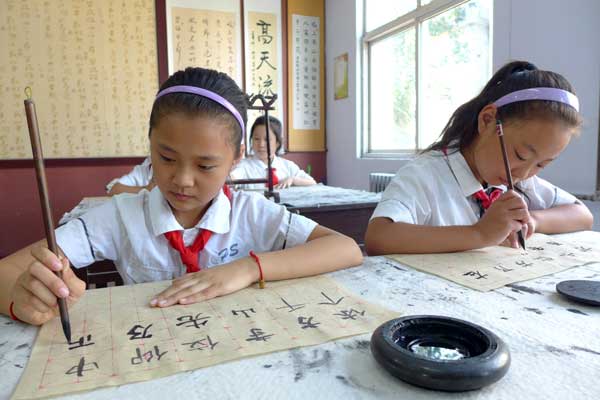
Students attend a calligraphy class at a primary school in Handan, Hebei province, on Monday.HAO QUNYING / FOR CHINA DAILY |
"These words were made up by netizens in a certain context and can be replaced by commonly used characters to represent the same meanings," said Wang Ning, a professor with the Beijing Normal University and leader of the team that compiled the list.
"We suggest people not overuse them in daily communications as it might mislead young students or foreign Chinese learners and trigger issues in the passing on of Chinese characters."
Only 45 new characters, mainly used in names of people or places, were added to the list, while 500 rarely used words were left out compared with the last edition released in 1986, said Wang.
Citing that some Web terms are only temporarily and regionally understood, Wang said it's unnecessary to include them on the list as "people will forget them or replace them with new characters eventually".
Jiang Lansheng, a language expert with the China Academy of Social Sciences, said only words that withstood the test of time made the list.
"The history of the evaluation of Chinese characters aims to preserve and pass on traditional Chinese culture. People should respect the process, take it seriously and use our characters carefully," Jiang said.
With the rise of digital technology, more people use pinyin input systems on mobile phones and computers, causing a decline in handwriting and recognition of characters.
The list provides a guideline for schools and local education authorities to improve students' cognition of words, said Li Yuming, a professor at the Beijing Language and Culture University.
"Teaching outlines at primary and middle schools will be updated according to the character list. Teachers can help their students recognize which words are high-frequency words," said Li.
To meet the requirement of compulsory education, from grade one to nine, and daily use, students should master the 3,500 characters in the list's first category. The 3,000 words in category two are recommended for those in the publication industry, dictionary compilation and information processing.
The 1,605 low-frequency words in category three are mainly used in names, scientific terms and traditional Chinese literature.
|
|
|



 Twin world champions pose for underwater wedding photos
 Chinese navy starts escort mission at Gulf of Aden
Copyright 1995 - . All rights reserved. The content (including but not limited to text, photo, multimedia information, etc) published in this site belongs to China Daily Information Co (CDIC). Without written authorization from CDIC, such content shall not be republished or used in any form. Note: Browsers with 1024*768 or higher resolution are suggested for this site.
License for publishing multimedia online 0108263 Registration Number: 20100000002731