No match for progress
 |
|
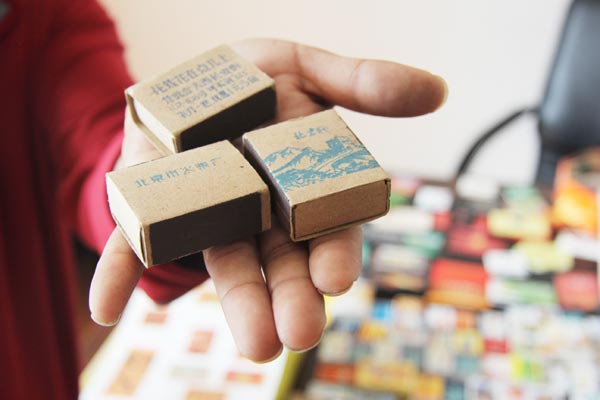
Matchboxes were once an indispensable part of daily life. |
The first box of matches to reach the country was a foreign envoy's gift to Emperor Jiaqing (1760-1820). Later in the Qing Dynasty (1644-1911), the match industry was brought to China by colonists mainly from Britain and Japan, who controlled the profitable business.
But matches were still a luxury, not a product for everyone, until industry took root in China.
In 1879, the country's first match factory was established by a Chinese businessman returning from Japan in Foshan, Guangdong province.
In 1906, the first match factory in Beijing was founded after Emperor Guangxu (1871-1908) accepted a proposal from a businessman named Wen Zuyun to "protect the national interest and booming industry". In 1953, it became the Beijing Match Factory.
In 1912, the Botou Match Factory was founded in Botou city in Hebei. After the founding of New China in 1949, it became the country's major match producer. The period of yang huo was gone and Chinese people had cheap matches in their lives.
In the golden years of the industry, there were over 130 match factories all over the country. Some big factories hired artists and painters to design the labels on matchboxes. In 1959, the China Academy of Fine Arts designed a set of 36 matchbox labels themed with Beijing landscapes, flowers and birds to celebrate the 10th anniversary of the founding of New China.
Since 1988, mass production of lighters, heating systems and gas cookers has improved the quality of Chinese people's lives, but those implements snuffed out the need for matches. In 1992, Beijing Match Factory shut down and was relocated to a suburban area.
Zhou Xiaofang, a co-owner of Zhenquan, the only shop in Beijing that sells matchbox labels and hosts a salon for collectors every two months, bought a whole room of matchbox labels at a low price, sold by the factory in 1992.
"I didn't realize there were people collecting the labels. I was just amazed by the beautiful patterns," Zhou says.
Many match factories in China closed then, leaving the market to Botou Match Factory, which enjoyed some lucrative years before its bankruptcy.
Han Qingsheng, the manager of Zhenquan, visited the factory with collectors and government officials in 2000.
"The factory produced at full steam day and night. The director still welcomed us and treated us in a good restaurant," Han recalls.
After a series of mergers with small factories, Botou Match Factory became the largest match producer in Asia, with its daily production capability reaching 7 million boxes per day, or 700 million matchsticks.
"A package of 1,000 boxes sold for only 26 yuan. Many local people made their living by sticking labels on matchboxes," Han says.
However, in 2004, when Han wanted to revisit the factory, he had to make an appointment. The factory didn't open every day due to its rapidly declining orders.
"In fact, a match is safer than a lighter and still useful in the remote countryside," Han says.
Despite changing times, Han says, "the culture of matchbox labels is preserved by museums and individual collectors like Wang". Zhou and Han still organize shows and holds label design competitions in primary schools.
Jia Chongzheng, 70, former deputy director of the Beijing Match Factory who started to work there in 1965, misses the golden days.
He retired in 1998 and lives frugally in an old residential building within the old factory zone. He feels regret for the downfall of the industry, but he sees an upside, too.
"Matches are inconvenient and consume a lot of wood. You have to face the progress of time and society," he says.
"The end of the match industry reflects the development of the country. I am happy to see it."