No match for progress
 |
|
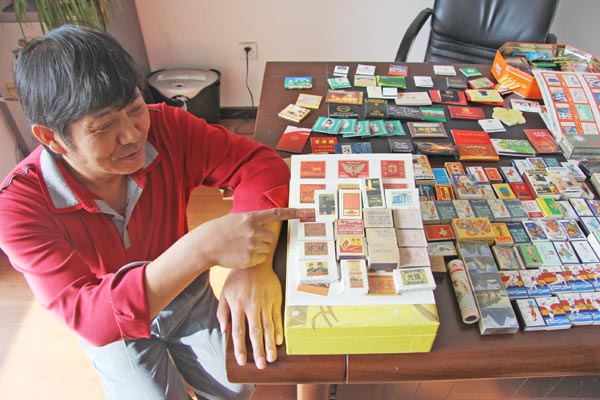
Beijing collector Wang Yuxiang and his matchbox collection. Photos by Wang Ru / China Daily |
Cigarette lighters and other conveniences have killed a once-essential commodity, but matchbox-label collectors are keeping the flame of a lost art alive, Wang Ru reports.
Related: Cases of fire
As time goes by, some things fade into history while other things pop up and thrive.
After the license-plate lottery began for private vehicles in Beijing, Wang Yuxiang's family-owned car-rental business boomed almost overnight.
But change hasn't always been kind to the Being native, 55, a passionate collector of matchbox labels. Wang heard some bad news in September.
Botou Match Co Ltd, the biggest producer of matches in Asia - 280 km away from Beijing in neighboring Hebei province - announced its bankruptcy.
"It is inevitable in times when few people use matches," says Wang, sitting in his office in Dongcheng district in Beijing.
"There are many fire-making tools now. The value of the match has gone," says Wang, who similarly notes that he seldom writes with a pen instead using a computer.
In the 1990s, there were about 40 match factories across China. According to Wang, only three are still producing matches now.
The existing match factories, like the oldest one in Beijing, now only produce orders from wedding planning companies and hotels. Some so-called match companies are in fact souvenir producers.
However, the story of the match has not been extinguished. Earlier this year, a nationwide convention of matchbox-label collectors, known as phillumenists, was held in Nanjing, Jiangsu province.
"The labels of matchboxes are full of information and aesthetic value, like stamps. I am glad to be one of the collectors who have recorded the stories of matches in China," Wang says.
Since the 1970s, when Wang saved his first matchbox label, he has been charmed by the colorful patterns that often represent diverse cultures, landscapes and characteristics of different regions.
Matches then were a necessity of life, when most people used them to smoke and to light coal stoves.
In the planned-economy era, a box of matches remained at the price of 2 fen or 0.02 yuan, affordable for daily use. "It was very common that some customers and neighbors came to borrow matches for lighting cigarettes or making their lunches," he says.
One year in 1970s, Wang's remembers, an official proposal to raise the price of a box of matches from 0.02 yuan to 0.03 stirred a wide debate.
A national newspaper published the proposal and discussion. The price was never raised.
The match industry witnessed the modern history of China. In the old days, matches were sometimes called yang huo, literally meaning "foreign fire".