Comments()
  Print
Print  Mail
Mail  Large Medium Small
In 1993, Tan composed a solo piano work using only the four notes C, A, G and E to commemorate his instructor.
Some 20 years later, the Beijing Music Festival (BMF) will present a special dialogue between the master and apprentice.
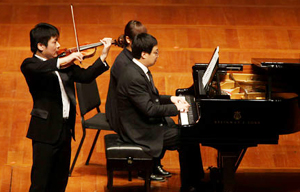
Tan will conduct a concert at Poly Theatre on Sunday, featuring Cage's works 4'33" and Atlas Eclipticalis, and his own three new works Atonal Rock 'n' Roll Overture Of Youth, Symphonic Poem of Three Notes and Concerto for Orchestra.
It's absolutely the one night in this year's BMF that is not to be missed - the coolest American musician and most controversial Chinese composer, plus an all-premiere program in China.
"As one of the most representative contemporary Chinese composers, Tan has taken broad influences from such composers as Philip Glass, Meredith Monk and Steve Reich," BMF's program director Tu Song says.
"John Cage started tracking Tan's career soon after he arrived in New York and greatly affected his concept of music creation - although, in fact, their relationship cannot be described as merely that of teacher and student," Tu says.
This year, the whole music world is celebrating Cage's centenary. The BBC Prom staged a concert featuring the London Sinfonietta performing Cage's 4'33".
"We planned this concert because we believe the dialogue between Cage and Tan is the dialogue between the West and the East," Tu says.
Tan believes Cage is special to China.
In early 1951, Cage got a copy of the I Ching, a classic Chinese text that describes a system of symbols used to identify order in chance events. He fell in love with the Chinese philosophy, which is usually used for divination, and employed it as a composition tool.
Most of his music since 1951 was composed using chance procedures, most of which are based on the I Ching. Atlas Eclipticalis is based on the star chart in the I Ching.
The I Ching, Zen and many other Chinese philosophies became Cage's lifelong interest.
Cage had tried to become a painter and architect before becoming a composer. He gave Tan several paintings. Most resembled Chinese ink paintings that use the technique of leaving blank space, Tan says.
Kang Xiao, doctor of musicology of China Conservatory of Music, says: "Cage largely changed the way people appreciate music and redefined the concepts of music and voice. Both 4'33" and Atlas Eclipticalis are perfect examples that offer glimpses of his musical concepts."
4'33" is Cage's most celebrated and controversial work. He said it was his most important piece.
If you expect to hear any music by traditional definition when listening to the piece, you'll be disappointed.
Silence is all you hear for four minutes and 33 seconds.
It premiered at Woodstock, New York, in August 1952.
People saw Cage's friend David Tudor sit at the piano and mark the beginning of the piece by closing the keyboard lid. Seconds later, he opened it briefly to mark the end of the first movement. He repeated this for the second and third movements, without hitting any keys.
In other words, the entire work consists of the sounds of the environment the audience hears.
"I believe it's easier for Chinese to understand the piece," Tan says.
"Our philosopher Lao Tzu says, 'the universe is boundless, and the loudest sound is silence'. Leaving blank space is important to Chinese painting."
Tan says that one China Philharmonic Orchestra performer cried after a rehearsal and said he'd never experienced such inner peace in his 25-year career.
Tan will innovate on the work. His version will use a Chinese guqin (seven-stringed zither), and the instrumentalists will lie on the stage for the first movement, sit for the second and slowly stand throughout the third. This represents a dialogue between Tan and Cage.
"Cage never came to China, and I believe he dreamed of visiting the country that created the I Ching," Tan says.
Tan's Atonal Rock 'n' Roll Overture Of Youth is dedicated to the 15th anniversary of the BMF. Tan writes music for a rock drum kit, which is truly rare for orchestral music.
"A person is considered to have reached adolescence at the age 15," he says. "It's a time of dreams, passions, revolutions and innovations. I use rock 'n' roll to portray dreams and passion. Atonality, which was first devised in the 20th century, pays homage to revolution and innovation."
The piece's musical motif, however, is a Peking Opera tune.
"It's a gift to the Beijing Music Festival, so I can't write it in Mozart's way, Beethoven's way or Tchaikovsky's way. Instead, I must create it in the contemporary Chinese way."
Symphonic Poem on Three Notes was composed to celebrate Placido Domingo's 70th birthday in 2011. The "three notes" refer to A, B and C, and the solfege of A, B and C is la, ti and do, which sounds like "Placido".
The orchestral concerto has been a preferred musical genre for composers since the 20th century.
"But the same orchestra sounds very different playing different composers' concertos," Tan says.
"The composer endows the orchestra with its identity. You can hear my identity - that of a villager from Hunan province, of a music student from Beijing and of a contemporary Chinese composer influenced by the West - in my piece."
Contact the writer at chenjie@chinadaily.com.cn.



Copyright 1995 - 2010 . All rights reserved. The content (including but not limited to text, photo, multimedia information, etc) published in this site belongs to China Daily Information Co (CDIC). Without written authorization from CDIC, such content shall not be republished or used in any form. Note: Browsers with 1024*768 or higher resolution are suggested for this site.
License for publishing multimedia online 0108263 Registration Number: 20100000002731