Comments()
  Print
Print  Mail
Mail  Large Medium Small
 |
|
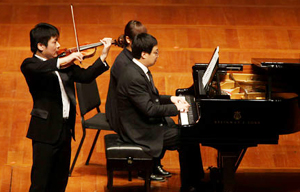
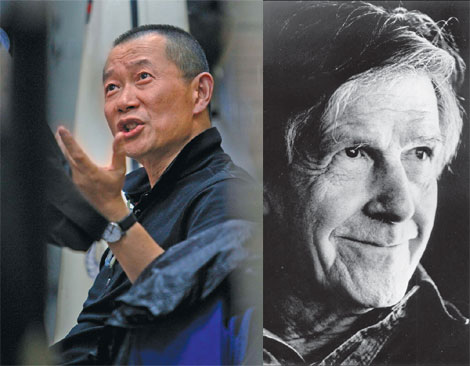
The Beijing Music Festival will present a special musical representation of the dialogue between composers Tan Dun and the late John Cage at Beijing's Poly Theatre on Sunday. Photos Provided to China Daily |
Eccentric composer Tan Dun pays musical homage to his equally unorthodox late mentor John Cage. Chen Jie reports.
In the fall of 1986, a young Chinese man played violin in front of a bank in New York City's Greenwich Village every day.
Passersby tossed quarters into his can. One day, three men stopped to listen and each left $20.
That violinist was Tan Dun, who'd just arrived in New York as a Columbia University doctoral student.
His three generous benefactors were John Cage, one of the 20th century's most influential musicians; leading American avant-garde choreographer Merce Cunningham; and Nam June Paik, who's arguably the world's first video artist.
It was the start of the informal mentor-pupil relationship between Cage and Tan.
The I Ching and Zen fascinated Cage, so he and Tan sometimes discussed these Chinese philosophies at Cage's Sixth Avenue apartment.
Cage was not only a well-known avant-garde musician but also an avid mycologist obsessed with mushrooms. Tan is a gourmet and enjoys cooking.
So besides talking music and philosophy, the experimental musicians often experimented with ways of cooking mushrooms.
Their unorthodox ideas increasingly grew together.
"What is very little heard in European or Western music is the presence of sound as the voice of nature," Cage once said.
"It is clear in the music of Tan Dun that sounds are central to the nature in which we live but to which we have too long not listened. In Tan Dun's music, the East and the West come together as our one home."
Cage died on Aug 12, 1992.
That morning, he and Tan discussed why people usually divide music into seven notes - do, re, mi, fa, so, la and ti - while Cage's teacher Arnold Schoenberg had devised dodecaphony (12-tone technique). Cage had developed another tone row technique, in which the row was split into short motifs repeated and transposed according to a set of rules.
Then, Cage told Tan he was writing a piece for a German orchestra that would take "three centuries" to play.
The next morning, Tan read of the maestro's death in the New York Times.



Copyright 1995 - 2010 . All rights reserved. The content (including but not limited to text, photo, multimedia information, etc) published in this site belongs to China Daily Information Co (CDIC). Without written authorization from CDIC, such content shall not be republished or used in any form. Note: Browsers with 1024*768 or higher resolution are suggested for this site.
License for publishing multimedia online 0108263 Registration Number: 20100000002731