Comments()
  Print
Print  Mail
Mail  Large Medium Small
Zhejiang's Chun'an county government plans to revive the culture of Lion City, which has been submerged under Qiandaohu, or Thousand Island Lake, since 1959, by creating an ancient-style commercial street in Jiangjiazhen.
Wu Min, office manager of Hangzhou Qiandaohu Xintiandi Property Co, the project's developer, says the government has designated a plot near Lion City Museum on the southwest corner of the lake. Planning is in the preliminary stage.
Construction of Lion City started in AD 621, although most of the buildings were built during the Ming (1368-1644) and Qing (1644-1911) dynasties, Wu says.
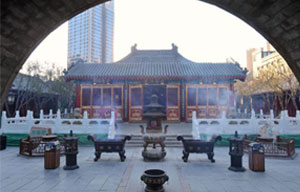
The street's architecture is the Hui style, which is characterized by white buildings, gray-tile roofs and the horse-head wall (which descends along the angle of the roof like a staircase).
It was not revealed how much the project will cost or when the street will open.
Lion City, along with the older town of He Cheng, which is also submerged under Qiandaohu, have been preserved like time capsules.
Since the construction of Xin'anjiang Reservoir in 1959 and the relocation of its residents, the urban centers have remained intact underwater. They were thereby saved from destruction during the "cultural revolution" (1966-76), when numerous ancient buildings were torn down.
Lion City, near Five Lion Mountains from which it takes its namesake in Sui'an county, comprises pagodas, memorial arches, a town god's temple, academies and tombs.
It also features a 2.57-km-long and 2-meter-wide city wall, which appears to be almost intact, based on recent underwater exploration.
Tian Dongmen, a 75-year-old former resident of Lion City and lacquer painter, says the old community was full of exquisite carvings and smart designs. Some rich households boasted decorative elements that are no longer seen.
For instance, guardian lions here are distinct from those traditionally placed in front of imperial palaces, imperial tombs, government offices, temples, and the homes of government officials, in that one of their paws is placed on a rotating ball.
"These are the masterpieces of our ancestors," Tian says.
Apart from the tangible relics, the ancient city also had distinctive folk customs, such as the lantern strings parade, or baizideng, during Lantern Festival. Dozens of small red lanterns were threaded on 3-meter bamboo poles, because residents believed that lighting them would bring offspring and good fortune.
Wang Yongming, a local culture scholar, says the government should assign researchers and interview former residents about the city's culture.
The government has already spent more than 28 million yuan ($4.45 million) on the Lion City Museum, which opened in 2011.
Featuring the traditional black-and-white Hui-style architecture, the miniature Lion City is based on historical documents, photographs, sonar exploration and interviews of former residents.
It also boasts an ancient map of the town and more than 800 photographs of its buildings and people.
A video explains the town's history to visitors.
"We want our descendants to know that our ancestors were brave and diligent, and it was a time when merchants didn't give short measures," Tian says.



Copyright 1995 - 2010 . All rights reserved. The content (including but not limited to text, photo, multimedia information, etc) published in this site belongs to China Daily Information Co (CDIC). Without written authorization from CDIC, such content shall not be republished or used in any form. Note: Browsers with 1024*768 or higher resolution are suggested for this site.
License for publishing multimedia online 0108263 Registration Number: 20100000002731