Henan bone flutes date back to 6,000 BC
Updated: 2011-09-06 11:55
By Zhang Zixuan (China Daily)
|
|||||||||


 |
|
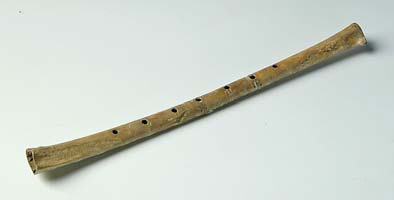
One of the 16 Jiahu bone flutes in the collection of Henan Museum. Provided to China Daily |
Editor's Note: Every week we look at a work of art or a cultural relic that puts the spotlight on China's heritage.
Music is as old as mankind and has taken as many forms as human evolution.
In 1987, 16 bone flutes which date back to around 6,000 BC were excavated from an early Neolithic tomb in Jiahu, Central China's Henan province. These bone flutes, the nation's oldest known musical instruments, are much older than flutes excavated in Mesopotamia and appeared 2,000 years earlier than in Egypt.
In ancient times, superstition and witchcraft were invoked to explain natural phenomena and bone flutes were used as the medium to link God and humans in sacrificial rites.
The Jiahu bone flutes, now kept in Henan Museum, and still playable, are made of the wing bones of red-crowned cranes and are about 20 cm long. They are open-ended and their finger holes vary from five to eight, although most have seven. The best-preserved one is 22 cm long and has seven holes.
Several half-way marks have been discovered on some of these bone flutes, which indicate that the number of holes and the distances between them were accurately measured and amended before drilling, to ensure they accorded with the musical range in which the flutes were intended to function.
Once these flutes were made, a smaller hole was sometimes drilled beside a few finger holes to correct the deviation of intonation. This technique is still in use in Chinese instrument making.
"The discovery of the Jiahu bone flutes has improved our understanding of Chinese music history stretching back 10,000 years," says Chinese music expert Xiao Xinghua, who has studied bone flutes for more than 10 years.
But the discovery of Jiahu bone flutes also leaves many unsolved mysteries, Xiao adds. For example, the finger holes are only 0.1 to 0.3 cm in diameter. How were such small and smooth holes drilled? What kind of tools did the flute makers use?
Another enigma concerns the flute makers' mathematical abilities and musical temperament. Only if both of these had existed to a high degree could they have determined the number of finger holes on each flute and their spacing so that all the finger holes were positioned to provide the perfect intonation on bones of varying length and thickness.