|
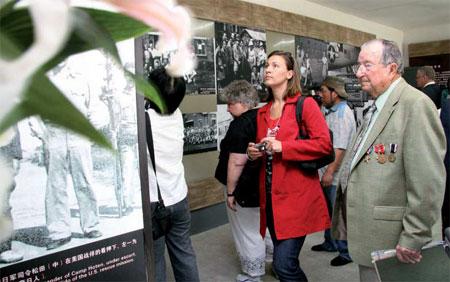
Historical photos of the Shenyang prisoner camp on display. Zhao Jingdong / for China Daily |
Museum sheds light on brutality and inhumanity of Shenyang concentration camp
You have probably heard of the notorious Auschwitz concentration camp in Poland - the biggest of its kind built by Nazi Germany during World War II. But you probably had no idea that there is an "oriental Auschwitz" - Shenyang WW II Allied Prisoners Camp, in the capital of Liaoning province.
"A total of 2,019 allied prisoners of war, or POWs, from such countries as the United States, the United Kingdom, Canada, Australia, the Netherlands and France were held here. Their average age was 26, 76 were brigadier generals and above, and nearly 300 died here," said Liu Changjiang, head of the museum at the former camp.
Liu said the Shenyang camp was the main one built by the Japanese army in Northeast China and is the best preserved of all the 18 prisoner camps built by the army.
The 45,355-square-meter camp consisted of three barracks, a hospital and an office for the Japanese army. A further 20 buildings included kitchens, canteens, toilets and boiler rooms.
The 12,000 square meter museum was built on the site with some original buildings preserved. The History of Shenyang WW II Allied Prisoners Camp and the POW Pictures are permanent exhibitions and include more than 500 photos and hundreds of documents and relics.
Prisoners of war suffered brutal enslavement at the camp from Nov 11, 1942 to Aug 15, 1945. Some died from starvation, assault, diseases and bacterial infections.
During the three years, the mortality rate was 16 percent due to "extreme brutality and inhumanity" with most of the causalities Americans, according to the museum.
"According to the statistics the mortality rate of prisoners in the Nazi concentration camps was 4 percent, while the rate was as high as 16 percent in this camp. As a result, the camp here was called the 'oriental Auschwitz'," Liu said.
Surviving POWs went back to Shenyang to visit the camp and told of the horrors they suffered to contribute to the museum, which is a reminder of the atrocities they experienced.
In 2008, more than 200 historical documents and relics, including mimeographed papers, photos, letters, books and military uniforms treasured by veterans were donated to the museum.
Another exhibit at the museum shows cartoons that depict life in the camp.
According to Liu, keeping a diary was strictly prohibited for the POWs. However captives William Christian Wartick, Patton Franklin Pinson and Marcus Fortier took advantage of their jobs at a Japanese-controlled workshop and smuggled pencils and paper back to their barracks.
They drew hundreds of cartoons to illustrate their work and life in the camp. The content of the cartoons varied from body frisking by Japanese soldiers, memories of their families, falling out a crowded bed to burning sleeping boards to ward off the cold. The images contribute to evidence of what life was like during that period of history.
liuce@chinadaily.com.cn
(China Daily European Weekly?08/29/2014 page16)

Copyright 1995 - . All rights reserved. The content (including but not limited to text, photo, multimedia information, etc) published in this site belongs to China Daily Information Co (CDIC). Without written authorization from CDIC, such content shall not be republished or used in any form. Note: Browsers with 1024*768 or higher resolution are suggested for this site.
License for publishing multimedia online 0108263 Registration Number: 130349