So, did hamburgers originate in China?
 |
|
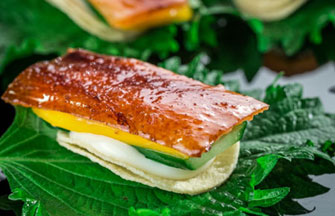
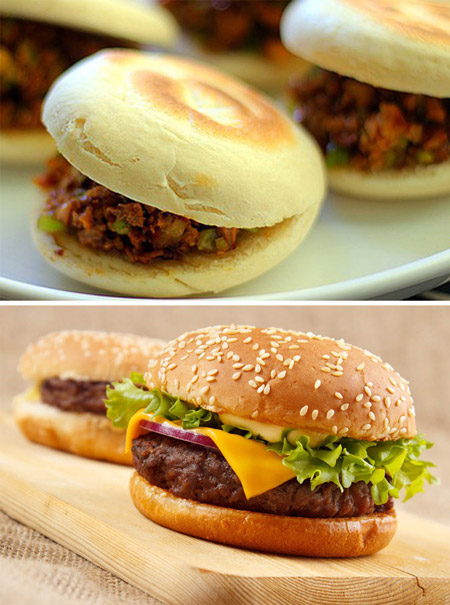
Rou jia mo (top), Hamburger (below) PROVIDED TO CHINA DAILY |
Heated online debate has been triggered over the relationship between hamburgers and rou jia mo, a Chinese snack that has been described as "the world's first hamburger".
Rou jia mo, which translates as "meat placed between bun", has a similar recipe to hamburgers, consisting of chopped meat inside a bun.
The street food originated in Shaanxi province in the Qin Dynasty (221-206 BC), according to United States-based online news blog the Huffington Post. According to local folklore, it may even date to the Warring States Period (475-221 BC) before the Qin Dynasty.
However, the earliest record of meat being sandwiched between pastry was found in documents from the Tang Dynasty (AD 618-907), according to Jia Zhigang, associate professor at the Faculty of History at Northwest University in Xi'an, capital of Shaanxi province.
"The meat sandwich originated in the royal palace and then it spread among the people. ... Given the celebrity effect and delicious taste, it soon became popular in the Guanzhong area (a prosperous area in Shaanxi)," Jia said.
Many claims have been made about the hamburger's origins. The earliest-known newspaper report on the topic appeared in the Chicago Daily Tribune in 1896, more than 1,000 years after the meat sandwiches were invented as a royal snack in China. This may explain why the Huffington Post refers to rou jia mo as "the world's first hamburger".
Several Chinese media outlets, including People's Daily and China Central Television, posted translations of the Huffington Post piece about rou jia mo on Sina Weibo on Friday, receiving thousands of comments and re-tweets.
Rou jia mo — with the chewy bun baked in a clay oven or fried in a pan and with a mouthwatering meat filling stewed in a variety of spices — is not only popular in China's streets and alleys but also with foodies overseas.
Xie Yunfeng, a Chinese vendor selling rou jia mo in front of Columbia University in New York, became an online sensation in 2013. Xie said he could sell more than 100 rou jia mo a day.
Commenting on the reported comparison between rou jia mo and hamburgers, one Internet user said, "People like eating meat by sandwiching it between buns, whether they are in the East or the West."
Lu Hongyan in Xi'an contributed to this story.