Don't turn blind eye to Hutong
Updated: 2007-04-28 09:18
 Most of the hutongs in Beijing run east-west or north-south. This is because most siheyuan were built along such axes according to the rules of feng shui and to take in more sunshine and resist cold winds from the north. Of course, not all hutongs follow the straight and narrow. There are also slant hutongs, half hutongs and blind hutongs. Beijing's shortest hutong is just 10 metres long and the narrowest is only about 40 centimetres wide. Some hutongs have more than 20 turns. As such, they are often a maze through which it is fascinating to wander, as long as you're not afraid of getting lost.
There is an interesting hutong called Qianshi Hutong near Qianmen (Front Gate). The narrowest section in its middle is only 40 centimeters. When two people pass through it face to face, one has to turn back to the exit of the Hutong and let another pass first. Interesting?
You may find that a lot of smaller hutongs have been formed inside bigger hutongs.
Hutong culture
In many people's minds, Beijing is associated with the hutongs. They are an important part of the culture and way of life of Beijingers, especially the older generation.
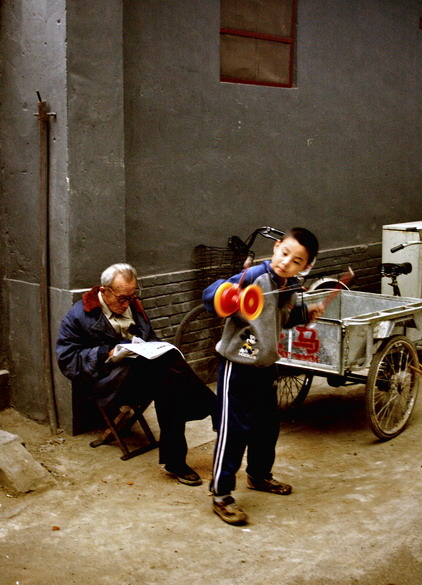
Walking through the hutongs, it is common to see groups of elderly citizens sitting together playing cards, mahjong or Chinese chess. In the early mornings and evenings, they gather to practice traditional forms of exercise such as taijiquan as well as to dance and sing folk songs or Peking Opera arias. Also important to hutong life is the traditional foods being sold in carts or small stalls. These change according to the season, from flavoured ice in the summer to long kebabs of crab apples covered in sugar in the autumn and winter.
So imporant are the hutongs to the culture of Beijing that there have been many operas, plays and films about them. Lao She (1899 - 1966), one of 20th century China's greatest novelists and playwrights, is responsible for one such homily. His "Teahouse" is set in what is often the focal point of a hutong community and brings together several characters from the old streets of Beijing to discuss the problems of traditional society. A more modern love song for the hutongs is Zhang Yang's "Shower" (1999) about a tradtional bath house where men from the community gather to drink tea, receive massages, fight crickets and escape their marital problems. The film laments the loss of such old ways of life as the hutongs are being knocked down to make way for modern blocks of flats.

