Tracing trade links through ceramics


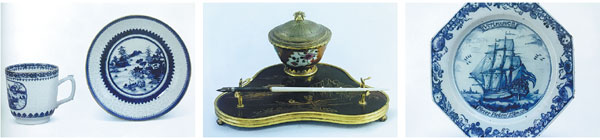
He says the exhibition shows only a small part of the tens of millions of Chinese ceramics that were shipped worldwide by European and American traders during the three centuries from the late Ming to the mid-Qing periods.
He says rough calculations show that the Dutch East India Company, for example, transported some 12 million pieces of Chinese ceramics between 1602 and 1682 to Asian countries and Europe.
Zhao Gang, director of the Jingdezhen Ceramics Museum that organized the exhibition, says the ceramics on show embrace in a vivid way "the openness, collaboration and mutual learning between civilizations".
He says that the exhibition is "a cultural testament" to China's Belt and Road Initiative.
The exhibition was first held at Zhao's museum for three months last year, and he says that 80 percent of the exhibits were produced in the kilns of Jingdezhen, a major production hub, while the remainder came from other kilns in China, or were produced by European artisans after they decoded the secrets of Chinese porcelain.
Ceramics helped introduce Chinese culture to the world through its designs: And they normally depicted scenes from fairy tales, such as the Eight Immortals and the classic drama Xi Xiang Ji (Romance of the Western Chamber).
Meanwhile, they made Western culture known to the Chinese, as the orders often required motifs that were familiar to European clients.
A plate on show was painted in underglaze cobalt blue and overglaze iron red and in the center it depicts a man and a woman walking in a garden.
Researchers believe they portray Louis XIV of France (or the Sun King) and his mistress. Although the two wear Western-style costumes, they have East Asian faces.
Another plate shows Greek mythology - The Judgment of Paris.
In the depiction, the three goddess and Paris the Trojan immortal have unrealistic physical attributes, showing the artisans' lack of knowledge about the human body.
Separately, ceramics meant for export that featured baroque and rococo decorations also influenced the tastes of Chinese porcelain makers and users.
For example, Qing Emperor Qianlong was influenced by European styles and ordered official kilns to produce wares with similar designs.
Other ceramics on display show that after arriving in Europe, the ceramics were reprocessed by local craftsmen who protected the fragile parts, such as the necks, mouths and handles with gold or silver coatings.
Or they changed the original functions of the ceramics by inlaying a bowl with a clock or turning a vase into a candle holder.
"In this respect, the exhibition celebrates the artisanship of the East and the West," says Zhao, the curator.