Tracing trade links through ceramics


 |
|
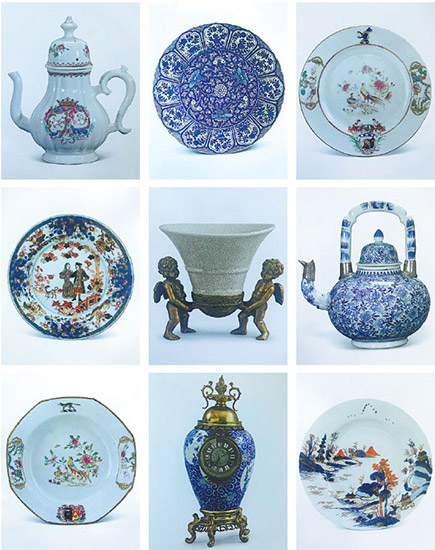
Ceramics on display at an exhibition called Return - A Ceramic Catalog of the Silk Road, at the National Museum of China in Beijing.[Photos Provided to China Daily] |
Exhibit focuses on pieces that traveled from Asia to Europe, mostly along the Maritime Silk Road
Some 300 years ago, ceramic artisans in Jingdezhen, in East China's Jiangxi province, received an order from Europe for a pair of plates as a marriage gift. So, the artisans crafted a round plate and an octagonal one, each fired with the armorial designs of the two families to be joined in matrimony. They also painted traditional Chinese patterns such as butterflies, rabbits and red candles on the plates.
The decorations on the plates were painted in rosy shades such as pink and carmine, known to people as colors of the famille rose (French for the "rose family"). The color combination was introduced to China by European missionaries around 1685.
Famille rose porcelain then became sought-after ceramics during the reign of Qing Emperor Yongzheng (1722-35).
A few years ago, the plates were acquired by a Beijing investment company at an auction.
They are now on show at an exhibition of Chinese ceramics, Return - A Ceramic Catalog of the Silk Road, at the National Museum of China in Beijing through June 9.
The exhibition showcases 300 pieces that were transported to different countries chiefly via the Maritime Silk Road and which have been bought by Chinese collectors over the past decade.
They date from the late Ming Dynasty (1368-1644) to the mid-19th century, when the trade in ceramics shrank following the Qing Dynasty's decline.
The objects include tea and coffee cups, dishes, ornaments and lamps. And they feature a variety of decorative and firing techniques, such as the blue-and-white and the doucai method in which colors and enamel were fired at different temperatures.
Wang Luxiang, a Beijing-based scholar and the exhibition curator, says extensive exploration during the Age of Discovery gave rise to global trade after the 16th century, and as a result, Chinese porcelain became "one of the first globalized commodities in human trade history".