Amid city babble, an old tongue sings again
|
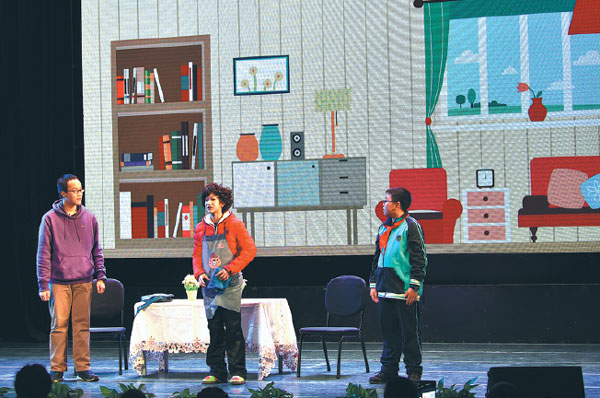
Huimin Middle School students in a play that was part of a contest aimed at promoting Shanghai dialect among youths.[Photo provided to China Daily] |
Li does not consider this a problem because Mandarin needs to be mastered for both education and work. English is also important, she said.
Experts believe parents have plumped for Mandarin and even English over local dialects much as people prefer cash crops over weeds, as Tan Dan Feng, a language historian in Singapore, was quoted as saying in The New York Times recently.
The decline of Shanghai dialect in today's globalization is neither new nor unusual. It has many predecessors or contemporaries such as the Hokkien dialect in Singapore.
Hokkien, once spoken by at least three quarters of the city state's population, has given way to the more internationally communicable Mandarin and English among younger people. It has created not only a sense of loss among older people, but also a communication barrier between the young and the old.
Kuo Jian Hong, an artistic director, said the loss of the mother tongue is one basis for the claim that "Singaporeans aren't too expressive", The New York Times said.
Any dialect that has survived for at least hundreds of years is more than a communication tool, linguists say.
Ding, the retired professor from Shanghai University, said Shanghai dialect has many expressions so unique that they cannot be translated into any other language.
"They wouldn't sound right or Shanghainese," she said.
Sharing this unique Shanghainese flavor through dialect creates a sense of belonging to the same community, Ding said.
Qian Nairong, a Shanghai dialect expert and the director of the Research Center of Linguistics at Shanghai University, said the dialect embodies Shanghai culture, an essential tag of being Shanghainese.
"Shanghai people are known for minding mainly their own business," Qian wrote in 2005. "Culturally the Shanghai dialect is the only character that binds them together, relating them to each other."
Bu Wenshan, who grew up in the city, is a saleswoman for a real estate developer. As her clients come from different parts of the country, Mandarin is her primary working language. However, she said, she would automatically shift to Shanghai dialect if she finds that the dialect is also her client's native tongue.