Amid city babble, an old tongue sings again
|
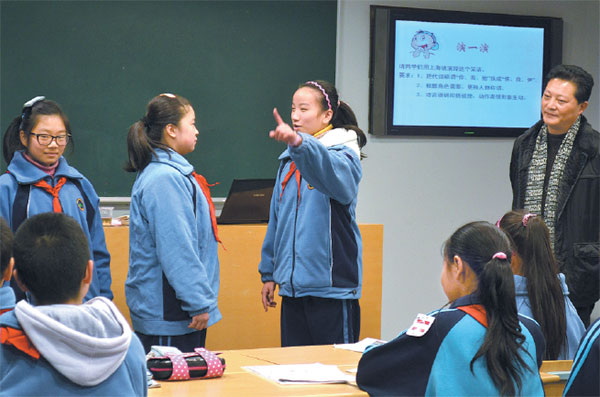
Students of Huimin Middle School in a Shanghai-dialect class.[Photo provided to China Daily] |
Zhang is typical of many young people in Shanghai whose limited ability to speak dialect has become the norm and raised concerns that the country's financial center will lose its native tongue. Linguists, scholars, political advisers and residents have rallied to rescue the dialect from extinction, but their success in that endeavor remains far from assured.
Shanghai dialect can trace its roots to the Wu dialect, one of China's oldest spoken languages, in use for more than 3,200 years. It has about 70 million speakers in areas around Shanghai and has its own grammar and vocabulary. Before the 1990s the dialect was widely used as the major language in Shanghai, equivalent to Cantonese in Hong Kong. Anyone speaking Mandarin in Shanghai was looked down on as provincial.
However, in recent decades, as the country's commercial capital has grown, the huge influx of people from other cities and countries has marginalized the city's native tongue. About 40 percent of the city's 24 million population were born other than in Shanghai.
The use of Mandarin has expanded not only among the migrant population but also among natives since the country began a nationwide campaign in 1992 to encourage its use in classrooms. In Shanghai, the campaign reached its peak between 1998 and 2008, when many schools banned the use of dialects, says Ding Dimeng, a retired professor of linguistics at Shanghai University who is keen on reviving Shanghainese.
Li Mengqian, 27, says that when she was in primary school in about 2000"we were not allowed to speak Shanghai dialect at school".
There were even students and teachers who monitored their use of language at school. If anyone was found speaking dialect they were ordered to desist, Li says.
The result is that those born in the 1980s and the 1990s have got used to speaking Mandarin and barely speak Shanghainese at school.
Li said her daughter, 4, knows how to speak the dialect because she has been raised by her grandparents whose primary language in daily communication is Shanghainese. However, things began to change last year when her daughter started kindergarten.
"She quickly picked up Mandarin and switched to that. My parents also started to talk to her in Mandarin."