MoMA acquires original emojis
 |
|
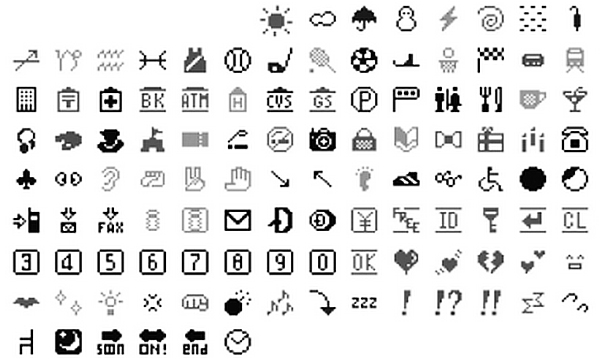
A set of 176 original emoji characters has been donated to the Museum of Modern Art in New York. [Photo/Agencies] |
The year was 1999 and the tiny 12-by-12 pixel designs-smiley faces, hearts of the intact and broken variety, cats, and so on-were mainly popular in Japan. In 2010, Unicode Consortium, which now controls emoji standards, translated the emoji into the Unicode standard, which means that a person in France, for example, can send an emoji to a person in the United States and it will look the same, no matter what brand of phone or operating system they use.
New York's Museum of Modern Art said on Wednesday that it has acquired the original set of 176 emojis. They were a gift to the museum from the phone company, Nippon Telegraph and Telephone.
"From the start (in 1929!), part of MoMA's mission has been to display and collect the art (and design) of our time," Paola Antonelli, senior curator of the Department of Architecture and Design at the museum, says. "Our time is lived today in both the digital and the physical space."
The museum's other digital acquisitions have included the "@" symbol and video games.
As to how a museum acquires something as ubiquitous as a keyboard symbol or an emoji, Antonelli noted design works differently than art, which in many cases is unique-think of a painting or a statue. Some design elements, such as the "@" symbol, are in the public domain, which means anyone can use them and the museum can simply display them.
The museum will show the emojis in its lobby through the year, using 2-D graphics and animations, and connecting the old emojis with the current generation.
Today, the Unicode Consortium recognizes nearly 1,800 emojis. There's wine, a baby bottle, a dancing woman in a red dress, and, of course, poop. There have been emoji-controversies, such as Apple's decision to replace the gun symbol with a bright green toy pistol.
The human faces in emoji have grown more racially diverse in recent years, and over the summer 11 new emojis were added representing female professionals, rounding out their male counterparts, thanks to a proposal from Google.
New emojis are added regularly, and continue to evolve and reflect our changing times.
"(Emojis) as a concept go back in the centuries, to ideograms, hieroglyphics and other graphic characters, enabling us to draw this beautiful arch that covers all of human history," Antonelli says. "There is nothing more modern than timeless concepts such as these."