


Emojis do the business
Social media apps are offering Chinese artists a shot at fame and riches
They are white, chubby and have sprigs on their heads - and Chinese social media can't get enough of them.
Roughly half the population has conveyed some kind of emotion with a Budding Pop emoji on WeChat, the instant-messaging app, making them one of the most popular in the world.
|
These emojis, created by an art student, were downloaded by 4 million users in one day. Photos provided to China Daily |
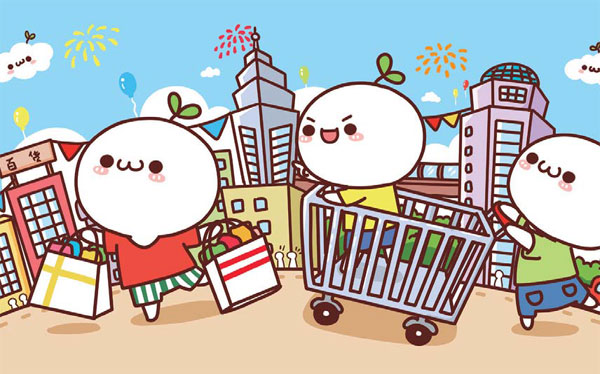
Liu Jingjing, 21, came up with the design three years ago. She is now a second-year art student in Shanxi province and works part time for 12 Buildings, a studio in Beijing. A fresh collection of 16 Budding Pop emojis released on March 12 was downloaded 4 million times within 24 hours.
"The number is stunning," says Wang Biao, the founder of 12 Buildings. "But that's what's happening in China - cartoonists are gaining instant fame by designing emojis."
Many of them hope this fame will lead to financial rewards, too, as it means they can potentially produce books for fans to buy as well as sell the rights for their characters to companies for marketing purposes.
12 Buildings has about 20 illustrators, about half of whom are college students. All of them were born in the internet era, Wang says. "They're very sensitive to new things online and can creatively weave them into emojis."
He says the way his team works is similar to the Japanese cartoon industry: artists design an original image and others contribute ideas to update the series. However, in China, many artists prefer to stay independent.
Zhong Wei in the northeast city of Shenyang has been drawing cartoons since 2014 and has published two picture books. Among the 32-year-old's creations is a white cat, which he has since turned into a popular emoji.
"Chinese internet users draw on emojis mainly to express emotions they can't express unaided," he says. To express various levels of anguish, for example, WeChat users can share an animation of the white cat crying while laughing, sobbing in a pool of tears, or wailing while clapping its hands.
Zhong has released three collections of the emoji via the instant-messaging app since August last year. Together, they have been downloaded 200 million times.
"A good emoji must be absolutely adorable, cheeky or naughty," he says. "Their expressions must be vivid and the body language rich."
China's emoji craze is rooted in Japan's kawaii (cute) and otaku (outsider) movements, he explains. "Chinese tend to communicate with friends using instant-messaging apps. We're open and talkative in the online world, but we turn in on ourselves and are less expressive in the real world."
Shi Donglin, 23, creator of the Freezing Gal emoji, believes the ultra-short animations can also help bring light relief at tense or embarrassing moments. For example, she says. "If I want to ask my boyfriend to buy a bag for me, I can use a coquettish emoji instead of having to resort to cold words."
Freezing Gal, which has dark skin and a ponytail, is based on her experiences in college and is popular among students.
Unlike traditional cartoonists, who generally created characters before selling stories to magazines or publishing houses, Shi launched her career via social media. In just a short while, she was producing work for instant-messaging tools like QQ and WeChat.
She says she will continue to make emojis and has now started on a series of picture books featuring Freezing Gal.
Cashing in while a character is hot is important, according to Xu Han, the artist behind Ali the red fox, another popular character. "The problem with the internet era is that, while a cartoon can quickly gain huge exposure and many fans, it can also be quickly forgotten," he warns.
He has sold 3 million copies of his Ali picture books since publishing the first in 2009. The fox, which Xu created in high school, was among the first emojis made available on the QQ messenger in 2012.
"Sina Weibo (a Twitter-like service) and WeChat offer good exposure to cartoonists, but if you want to cultivate a good brand you need more than an emoji," he adds.
Wang at 12 Buildings agrees that it is hard to guarantee longevity, but he believes the internet provides opportunities for budding Chinese illustrators to work with major brands that would previously have opted for foreign talent.
Budding Pop is now featured in promotions by Procter & Gamble, the multinational consumer goods company, while smartphone maker Xiaomi is using Freezing Gal to reach new buyers.
"China has never lacked good cartoonists," Wang says. "It has just lacked ways to promote its brands. Emojis give it the chance to do so effectively."
dengzhangyu@chinadaily.com.cn
















