At Palace Museum, the world mulls heritage protection
 |
|
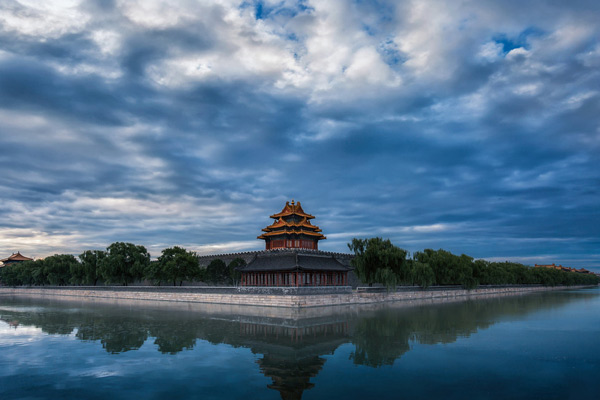
A view of the scenery of the Turret of Palace Museum. [Photo/IC] |
In 1977, careful restoration work began on this splendid piece of art, and after eight months it was restored to its previous splendor.
Stories of treasured Chinese antiques and artifacts being given a new lease of life have gone on within the red walls of the Forbidden City.
Earlier this year, "Masters in the Forbidden City," a China Central Television documentary that profiled the work of the museum's restoration department became an unexpected Internet hit. It clocked up over four million views and scored an impressive rating of 9.5/10 on a major video-streaming website in China.
The responsibility, inner peace and persistence of the technicians have made them "idols" among many of the post-80s and post-90s generations.
"It is important to attract young people, who have developed higher expectations on museums," De Caro said, noting this challenge is faced by museums worldwide .
De Caro also spoke highly of the opening-up of this once-forbidden space.
In 2002, only 30 percent of the Forbidden City was open to the public, last year this rose to 65 percent, and soon 80 percent of the complex will be accessible, according to the Palace Museum.
To commemorate its 90th anniversary last year, the museum opened freshly restored sections including the Palace of Longevity and Health and the Garden of the Palace of Compassion and Tranquility, both used by Ming and Qing dynasty empress dowagers, as well as its southeast corner tower.
This forum aimed to generate solutions to common problems in preserving world cultural heritage and to seek ways of sustainable inheritance of human civilizations.
It brought together leading archeologists, historians and museologists from ICCROM, the International Council of Museums (ICOM), International Council on Monuments and Sites and eight countries known for their ancient civilizations -- Egypt, Greece, India, Iran, Iraq, Italy, Mexico and China.
Over 40 professionals from various countries signed "The Declaration of Supreme Harmony," appealing to countries with great civilizations to strengthen communication and better protect cultural heritage.
The inheritance of social and cultural traditions brings the global community closer, said Shan Jixiang, director of the Palace Museum.
"Protection and development of the world's cultural legacies does not only boost international cultural exchanges but also helps shape the memory and identity of a nation," Shan said.
Preserving and sharing culture of the ancient civilizations is a global theme, Hans-Martin Hinz, former ICOM president, told Xinhua. "The Palace Museum's contributions are visible to the rest of the world."
In 2013, ICOM, then headed by Hinz, founded its first international museum studies training center at the Palace Museum. The center is committed to training professionals, particularly those from less developed countries, in order to enhance their capabilities of managing museums.
"Some African countries, which are very different from nations in the European Union or East Asia, really need help," Hinz said, noting that the Palace Museum and the Chinese government have provided strong technical and financing support to help museum employees from Africa.
Hinz said the training center is a success and the ICOM is considering to establish a second overseas center.
Elham Aly, head of museums under the Egyptian Ministry of Antiquities, has 27 years of experience managing museums in Egypt.
This is her first trip to the Palace Museum, which she described as an institution of "passion and history."
"Ancient palaces in Egypt are almost no longer tangible. I am impressed by the maintenance of the huge Forbidden City. I value the Palace Museum's mission, vision and policies. We should keep it forever," Aly remarked.
Shan, who visited the conservation center of the Grand Egyptian Museum under construction, said he was also impressed by its scale and technologies, acclaiming the center a world-class restoration platform which the Palace Museum wants to have in the future.
De Caro, an Italian, advised China to build a cultural academy in Rome to promote Chinese classical arts and restoration techniques, as France and Japan have done.
"Cooperation in preserving cultural heritage and carrying forward the ancient civilizations is important. It shapes a generation," De Caro said.
"To be attractive, culture is first," Aly said. When asked if she wants to visit the Palace Museum for more exchanges, she replied, "why not?"