 |
|
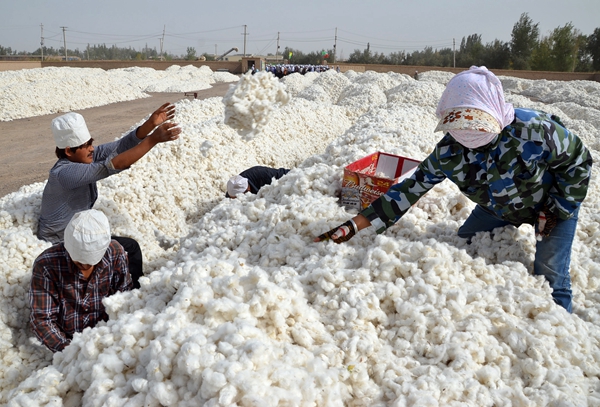
Members of the Xinjiang Production and Construction Corps place harvested cotton in the sun to dry.[CHEN JIANSHENG/CHINA DAILY] |
Transformation
Cui, a trained livestock specialist, and her colleagues have accomplished the successful transformation of a Bingtuan unit grounded in agriculture into one founded on industry and services.
Cui explained that the strategy was designed to help the city "relocate its old and increasingly crowded market outlets to vacant, peripheral land" under the division's control.
Spacious - enormous by the standards of other Chinese cities - markets have been built to house suppliers of cars and trucks, farm products, and construction materials and machinery.
The 12th Division's 150,000 members provide the work force for its seven companies, seven large plantations, which cover a combined 20,000 hectares, and seven ranges of about 200,000 hectares of grassland.
Farming and animal husbandry are no longer the main source of the 12th Division's revenues. In 2014, more than half of the 13 billion yuan ($2 billion) generated was provided by the service sector, which earned 7.3 billion yuan. Industrial activity accounted for 4.8 billion yuan, and just 0.9 billion yuan came from agriculture and animal husbandry.
"We also have an industrial park, which has attracted investment from technology companies, and our own companies are listed on the national stock exchanges," Cui said.
Her career path reflects the many changes the division has weathered. "The first mission the Bingtuan assigned me was to raise sheep. The second was to slaughter them and produce more meat at a time when China was in the early stages of a market economy. My current mission is, as it were, to sell sheep, or every value-added product that can be generated by local resources," she said.
"I can retire satisfied now that the previous two missions have been completed, and the third has started successfully and can be passed on to my younger colleagues."
Although the Bingtuan is upgrading itself via industrialization and urbanization, thanks to its large tracts of flat farmland and the use of advanced machinery and technology, agriculture is still a major part of the organization's activities.
At 960 sq km, the Fangcaohu Plantation, run by the 6th Division, is huge. It accounts for one-10,000th of China's entire landmass, and the area under cultivation is 40,000 hectares, with more than 60 percent devoted to cotton.
Xinjiang produces half of China's cotton, and one-third of the cotton planted in the region is grown by the Bingtuan. Fangcaohu, which claims to be one of the largest State-owned farms in the country, is the unit's biggest cotton producer.
"If we can obtain more water for irrigation, we can grow more cotton. Water is the most important thing for everything in arid Xinjiang," said Shi Zhongyan, political instructor of the 5th Company's Sub-Farm No 6.
According to the 48-year-old second-generation Bingtuan man, modern agricultural technology allows a larger number of plantations to be irrigated, but with lower water use. "The farm workers can control the supply of water and fertilizers via computers. They can take care of their farmland without physically being here," he said.
Related Stories
Copyright 1995 - . All rights reserved. The content (including but not limited to text, photo, multimedia information, etc) published in this site belongs to China Daily Information Co (CDIC). Without written authorization from CDIC, such content shall not be republished or used in any form. Note: Browsers with 1024*768 or higher resolution are suggested for this site.
License for publishing multimedia online 0108263 Registration Number: 130349