 |
|
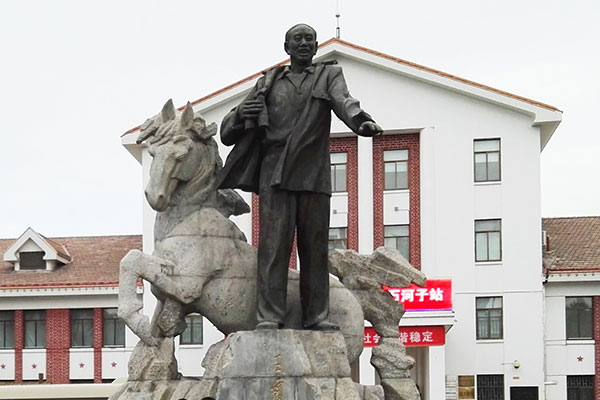
A statue of Wang Zhen (1908-93) at the Bingtuan Museum in Shihezi, Xinjiang.[ZHANG XIAOGANG/CHINA DAILY] |
The transformation of People's Liberation army units into an economic force was driven by one of China's best-known soldiers, as Ed Zhang, Cui Jia and Mao Weihua report from Shihezi in the Xinjiang Uygur autonomous region.
One man's story is of overarching importance in the history of modern Xinjiang; that of Wang Zhen (1908-93), who led the People's Liberation Army forces that took the region from the Kuomintang government, not by force, but by negotiating a peaceful liberation deal in 1949.
In the 1950s, Wang was equally active, supervising the conversion of many of those combat units into the earliest divisions of the Xinjiang Production and Construction Corps, a quasi-military force that exercises administrative control over several cities as well as farms and industrial facilities.
Officially, Wang was stationed in the Xinjiang Uygur autonomous region for just four years, from 1949 to 1953. But later, he traveled back and forth and made many trips to China's westernmost corner, mainly to plan the development of the XPCC, or "Bingtuan" as the corps is known locally.
A legendary figure
Wang remains a household name as a Bingtuan hero - a legendary character in modern China's efforts to defend and build Xinjiang.
To gauge the depth of public affection for Wang, visitors only have to pay a visit to the Bingtuan museum in Shihezi, a new industrial center in the north of the region served by airlines and express rail services, and the largest city built by the corps so far.
The museum is housed in the building that was used by the officials who oversaw all the land reclamation projects around Shihezi in the 1950s and '60s. The areas are now subdivisions of the Bingtuan's 8th Division.
A statue of Wang stands outside the front gate of the museum, and at weekends it serves as a meeting point and center of activities for a sizeable proportion of the city's population of more than 500,000.
People arrive, one group after another, to pose for photos with the statue. They include wedding parties, family tours, reunions of retirees and old classmates, school tours, and of course, museum visitors.
Congregating near the statue has become a ritual in Shihezi, as is obvious to even the most casual observer, and the locals derive a sense of worth and pride by remembering the man who labored alongside the city's first generation of builders.
Cui Ling, director of commerce and investor relations for the Bingtuan's 12th Division, is proud of her family history: "I'm a second-generation Xinjiang native. My father was a PLA soldier who followed General Wang Zhen to Xinjiang when he was stationed in Kashi (the local name for Kashgar in the south of the region)."
In 1949, most PLA soldiers were expected to march to Xinjiang, so Wang arranged a fleet of trucks to transport many of them. For the others, though, the conditions were so poor and the tasks ahead so urgent that some soldiers rode camels and cut through the 400-kilometer-wide Taklamakan Desert.
Nowadays, things are easier for members of the 12th Division and physical strength is no longer an essential asset. Being headquartered on the outskirts of Urumqi, the regional capital, has given the division an economic advantage. During the development of the local business sector "we were prepared from the outset to embrace the inevitable overflow of the city's commercial functions," Cui said.
Related Stories
Copyright 1995 - . All rights reserved. The content (including but not limited to text, photo, multimedia information, etc) published in this site belongs to China Daily Information Co (CDIC). Without written authorization from CDIC, such content shall not be republished or used in any form. Note: Browsers with 1024*768 or higher resolution are suggested for this site.
License for publishing multimedia online 0108263 Registration Number: 130349