Nation's first internet court up and running
 |
|
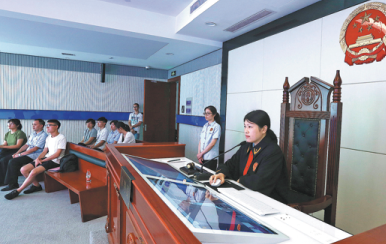
A judge hears a case on infringement of information-dissemination rights at the Hangzhou Court of the Internet on Friday.[Qin Lubin/For China Daily] |
China has set up its first court specializing in handling of internet-related disputes in Hangzhou, Zhejiang province, where many technology enterprises are located, amid rapid growth of online purchases and financial activities in the country.
The Hangzhou Court of the Internet is responsible for hearing six types of civil and administrative internet-related cases in the city, such as those involving online intellectual property rights and e-commerce disputes. It will also handle other web-related cases designated by higher courts, according to the top court.
"The establishment of the court is to meet the growing legal demand from litigants. It will also help the public to solve online disputes more effectively," Zhou Qiang, president of the Supreme People's Court, said after visiting the court on Friday.
He said the new court will play an important role in maintaining a safe internet and must provide good legal service to litigants.
A key feature of the court is that it allows litigants to handle a lawsuit entirely online. From case filing to the court hearing, litigants do not have to go to the court in person, according to Zhu Shenyuan, vice-president of the Zhejiang Provincial High People's Court.
"Our aim is to make court hearings keep pace with the fast development of cyberspace and to explore new ways of hearing lawsuits so that it can be expanded across the country," Zhu said.
People can register at the court's website-netcourt.gov.cn, which includes an English-language version-and then provide evidence and materials. Defendants will be notified via text messages if the court files the case.
Judges will inform both parties of the trial time, and then those involved can log in to the website's trial page, which uses a remote video system, according to Zhu.
The new internet court is a district-level court, and if litigants disagree with the verdict, they can appeal to the city's intermediate people's court, he said.
Cheng Jianle, deputy director of the provincial high court's research office, said the court's location was carefully chosen.
Hangzhou is home to such technology enterprises as Alibaba, the company behind the Alipay mobile payment system, and the Taobao online marketplace. Because of this, the city has witnessed a soaring number of online disputes in recent years, he said.
According to the provincial high court, Hangzhou courts handled about 10,000 cases related to e-commerce last year, up from about 600 in 2013.
A trial operation of the internet court, guided by the top court, began in May. On June 26, the establishment of the court was formally approved at a meeting of the Leading Group for Overall Reform presided over by President Xi Jinping.
As of Tuesday, it had accepted 2,605 cases since May, of which 1,444 have been concluded. In the court's litigation service center, a digital screen showed that more than 1,200 of the accepted cases were related to defective online products, followed by conflicts caused by online piracy and e-commerce contracts.
The average time of hearings conducted online was 25 minutes, according to the internet court.
"The online hearings make our work more transparent and facilitate litigants," said Du Qian, president of the internet court, adding that the court will enhance technology support to prevent network failures.
Zhou Hanhua, a law professor at the Chinese Academy of Social Sciences, said the court represents progress, since it's the first to put all legal proceedings online. "But the court still faces challenges, such as how to facilitate those litigants who are not familiar with the internet."
Yang Ming, deputy director of the internet law center at Peking University, said that authenticating evidence provided online needs further study.