For visually impaired, Braille no longer king
 |
|
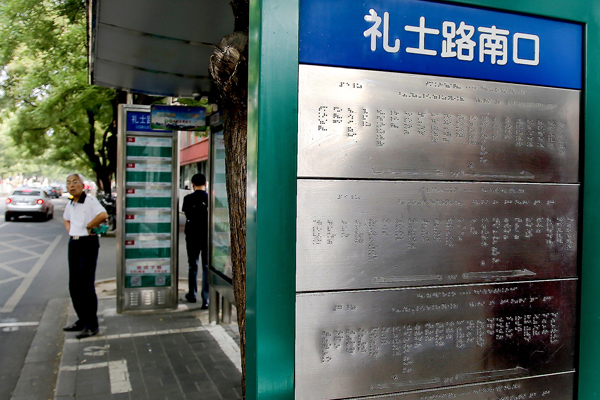
A signboard in Braille at a bus stop in Beijing's Xicheng district in July. [Photo by Wang Fei/China Daily] |
New generation finds audio more convenient as technology advances
While happy about the move to present maps and bus schedules in Braille at bus stops, advocates for the visually impaired are calling for more facilities to meet the needs of residents with sight loss.
The authorities placed 16 Braille signboards and 95 route maps in four areas across Beijing's Xicheng district in 2015 as part of an effort to improve accessibility.
But people with visual disabilities, or who are engaged in related industries, said that they had heard little about it. And they suggested that Braille may not be the best way to help visually impaired passengers.
An employee at Xicheng's housing commission, who was not named, told Beijing News that the four areas were chosen because research had shown those places had heavy demand for Braille, and that experts had been consulted to ensure the Braille translations were accurate.
Yan Xiaoqiang, who works at a school for the visually impaired in Beijing's Haidian district, said that even with the signboards and maps in Braille, the passengers using them still had problems figuring out the bus they wanted to take.
Instead of Braille signboards and maps, Yan said, it would be more practical for bus stops to be equipped with audio speakers that announce where the next bus is heading.
"After all, hearing is the major source of information for us," said Wang Hua, a massage therapist in his 30s who is currently seeking a job in Beijing.
Li Qingzhong, chairman of the China Blind Persons' Association, said that easier and more practical things can be done to help visually impaired passengers, such as using signboards with larger characters, increasing the contrast of the characters and the background and lowering the height of signboards, noting that around 90 percent of the roughly 18 million visually impaired people in China can see to some degree.
Others interviewed suggested that rapidly changing technology is undercutting Braille, which was the only way for the group to access information in the past.
Li said that while many visually impaired people can read Braille today, knowing the language is no longer as important as it was two decades ago.
Wang, the massage therapist, said Braille is losing its appeal for the younger generation in the digital age.
"I've been learning Braille for some time but still cannot use it proficiently. It is rather complicated. I think the younger generation of visually impaired people is more reliant on voice-assisted apps, because they are super convenient," Wang said.
In 2012, the central government implemented a regulation to guarantee construction of barrier-free public facilities.
"It's good to see that laws and regulations are in place to ensure the rights of the disabled, but there's still a long way to go before the policies translate into tangible, practical benefits for the group," Li said.
Li Lei contributed to this story.