Questions arise on laws granting time for parental care
As some provinces introduce or draft new regulations to provide leave to the only child of families to take care of ailing parents, doubts have emerged on the fairness of, and ability to implement, such regulations.
In recent weeks, provincial laws have been introduced or are being drafted in several regions nationwide. These require an employer to give at least three days' leave per year to an only child for taking care of sick parents who are older than 60.
On March 1, Fujian province included such a requirement in its Protection Act for Elderly People's Legal Rights. It allows an only child to have a maximum of 10 days, with wages paid, to take care of parents who have been hospitalized.
Similar regulations were introduced into the draft of the act in Hubei province in May, in Sichuan province in June and in Chongqing municipality in July. In the Guangxi Zhuang autonomous region, a similar regulation will be enacted on Sept 1.
The regulations of each province differ on the number of days allowed for leave. In Sichuan, a minimum of three days is specified, while in Henan the maximum is 20 days.
"But there is still a question of whether such regulations can be successfully implemented, especially in some privately owned companies," said Professor Qiu Zeqi, director of the Center for Sociological Research and Development Studies of Peking University.
Some who are not the only child of their family see the new regulations as unfair and say the requirements are not the solution to the problem of an aging society.
Jia Biao, 33, works in Beijing, but his parents live in Tai'an, Shandong province. His younger sister now lives in New Zealand and comes back to China just once a year.
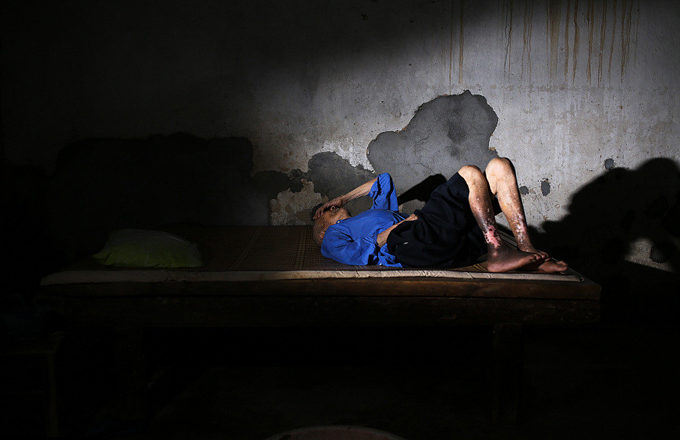
Jia's 61-year-old father broke an arm and was hospitalized two weeks ago. Jia begged his boss for a week off and took care of his father in Tai'an. He said he was paid no wages for that week.
"The new regulation was issued with very good intentions. But it only gives privilege to the only child, which is unfair," Jia said.
Additionally, he said the age limit of sick parents-older than 60-is unreasonable. "Age should not be a standard to decide whether the parent needs care or not," he said, adding that it should depend on the parent's condition.
Many young people in China face a situation similar to Jia's. They seek a better life in big cities, leaving their parents in their hometown. But once the elderly become ill, they face the problem of getting their children to return to care for them.
According to the National Bureau of Statistics, China has nearly 231 million people older than 60, accounting for 16.7 percent of its total population. It is estimated that the country will have about 400 million people older than 60 by 2035.
Li Mingshun, deputy director of the China Law Society's Institute of Marriage and Family Law, said: "Maybe it still needs to be revised, but the new regulation is a good try. Evaluating how it has been practiced after a period of time will help the government to decide whether it can be written into national laws."